
Exploring Limb Brightening: Centaurus A's Mysterious Jets
Researchers explore limb brightening in Centaurus A's jets, revealing insights into black hole physics and connections to future fusion energy developments.
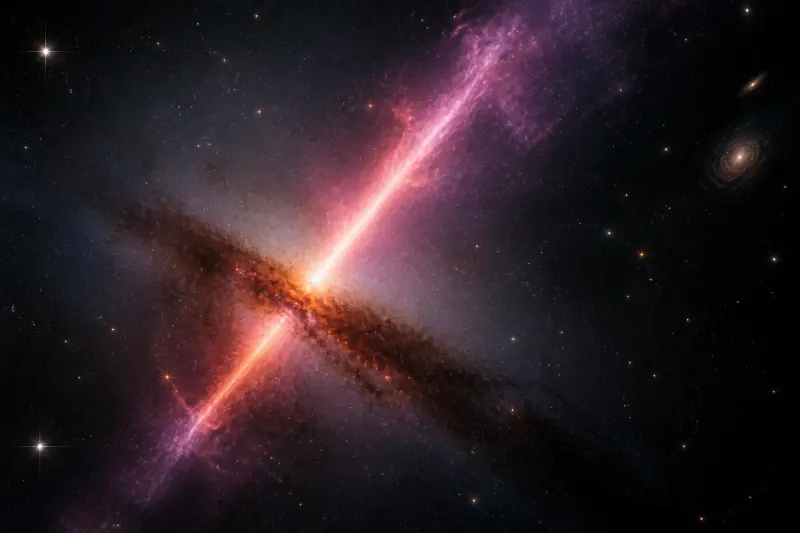
The Giant Astrophysical Jets of Centaurus A
Astrophysical jets, especially those originating from supermassive black holes (SMBH), are among the most spectacular features in the cosmos, emitting vast amounts of electromagnetic energy across space. These jets are driven by the rotation and magnetic forces surrounding active galactic nuclei (AGN), precisely the regions where SMBH are pulling in significant amounts of matter from their accretion disks. Centaurus A, the closest radio galaxy to Earth, is a prime example of such a phenomenon and has been a focal point for researchers aiming to understand the mechanics behind black holes and their jets.
Recent observations of Centaurus A have revealed a puzzling aspect of its jets: they appear to be brighter on the edges than in their centers, a phenomenon identified as limb brightening. This contradicts the expectation that the center of the jets should contain the most concentrated energy, leading to significant interest and investigation among astrophysicists.
Understanding Limb Brightening
With numerous studies focusing on the jets of Centaurus A, researchers have utilized data from the Event Horizon Telescope (EHT), which has provided high-resolution images over a decade. Observations have demonstrated that limb brightening is not unique to Centaurus A; it has also been noted in other galaxies such as M 87 and 3C 84. This raises questions about the underlying physics that cause variations in jet brightness across different SMBHs.
Research led by Felix Glaser, a Master's student at the University of Würzburg, has provided new insights into this phenomenon. In the paper titled "Probing anisotropic particle acceleration and limb brightening in Centaurus A’s jet," Glaser and colleagues hypothesize that the brightness variation is due to anisotropic particle distribution in the jet. This means that the electrons moving within the jets do not follow a uniform distribution, leading to differences in brightness observable in the jets of Centaurus A.
Exploring the Jet Structure Through High-Resolution Simulations
The research team employed a series of magnetohydrodynamic simulations to model the behavior of plasma around the SMBH in Centaurus A. They took into account general relativistic effects due to the high speeds at which these jets travel, which can approach the speed of light. Their simulations showed how adjustments to parameters like black hole mass and viewing angle affected the appearance of the jets, aligning well with the observations made by the Event Horizon Telescope.
Synthetic Polarized Intensity Images for Centaurus A
| Frequency | Panel A | Panel B | Panel C | Panel D |
|---|---|---|---|---|
| 86 GHz | Detail Level: Basic | Detail Level: Intermediate | Detail Level: Advanced | Detail Level: Expert |
As part of their simulated observations, the researchers produced synthetic polarized intensity images at four frequencies (86 GHz, 230 GHz, 680 GHz, and 3 THz). Each frequency gives a closer look at the structure of the jets, highlighting how different parameters influence the jets' appearance at varying observation frequencies. The work suggests that the edge-brightening observed can be naturally produced through an anisotropic distribution of particles within the jets.
Implications of Research on Astrophysical Jets
This research not only sheds light on limb brightening in Centaurus A but may extend to a broader understanding of relativistic jets across the universe. Dr. Christian Fromm, leader of the Computational Astrophysics Group, emphasized that understanding small-scale plasma actions can have implications for larger phenomena, making detailed observational efforts crucial moving forward.
The promising results from this pilot study suggest that future telescopes, like the Square Kilometre Array set to launch in 2027, will further contribute to our understanding by providing higher resolution imaging of black holes and their energy emissions.
The Connection to Fusion Energy Research
Interestingly, the insights gained from studying these astrophysical jets could also benefit fusion energy research. The principles governing plasma behavior in black holes mirror the conditions required for successful confined fusion reactions on Earth. This is illustrated through the construction of the ITER fusion reactor in France, which uses powerful superconducting magnets to confine hot plasma under precise conditions.
Future Observations and the Importance of Realistic Plasma Physics
New advancements in observational technology are anticipated to enhance our understanding of relativistic jets. As telescopes like the Very Large Array undergo upgrades by 2031, the capability to observe and analyze such phenomena will drastically improve. The continuous evolution of our understanding hinges on integrating realistic plasma physics into models, enabling scientists to grasp the nuances of jet formation, energy emissions, and implications for both astrophysics and practical energy applications.
Key Takeaways
- Centaurus A's jets exhibit limb brightening, where the edges are brighter than the centers, defying typical expectations.
- High-resolution simulations provide insights into the mechanics of these bright edges, linking particle distributions to observed brightness variations.
- Synthetic polarized intensity images reveal how frequency variations affect the appearance of jets, highlighting the importance of observational astronomy.
- Future advancements in telescopes will enhance understanding of black hole jets, with potential benefits for fusion energy research.
This thorough examination of Centaurus A's jets not only unravels the enigma of limb brightening but also reinforces the interconnectedness of astrophysical research with practical applications on Earth. Through multi-disciplinary approaches, researchers are unlocking detailed mechanics of some of the universe's most powerful phenomena, suggesting ongoing explorations will yield even more groundbreaking revelations.
Frequently Asked Questions