
Harnessing Diffractive Solar Sails to Deflect Killer Asteroids
Research from Beihang University highlights the potential of diffractive solar sails to create a game-changing method of asteroid deflection at unprecedented speeds.
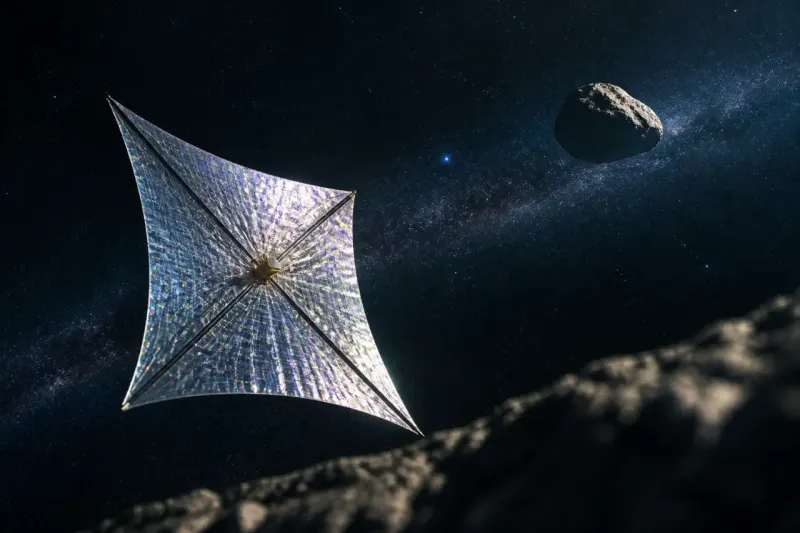
Asteroids: The Unseen Threats
Asteroids pose a real threat to Earth, yet we often remain blissfully unaware of their potential danger. Thousands of new asteroids are discovered every year, with some having orbits that could lead them to cross paths with our planet. While there are currently no known asteroids on a collision course, advancements in asteroid detection technology have led to a heightened awareness of their risks. The successful Double Asteroid Redirection Test (DART) mission provided a proof of concept for deflecting a dangerous asteroid using a kinetic impactor, essentially a projectile designed to alter the asteroid's trajectory. However, this method comes with limitations based on timing and trajectory mechanics.
The DART Mission's Limitations
The DART mission successfully collided with the asteroid Dimorphos at a speed of approximately 6 km/s. While the results were promising, the impactor was limited by its approach direction, striking the asteroid from behind, which diminished the overall energy transferred during the impact. This highlights a significant challenge in the kinetic impactor method: to effectively redirect an asteroid, there needs to be sufficient warning time, allowing for years of planning and orbital adjustments.
Innovative Solutions: The Solar Sail Approach
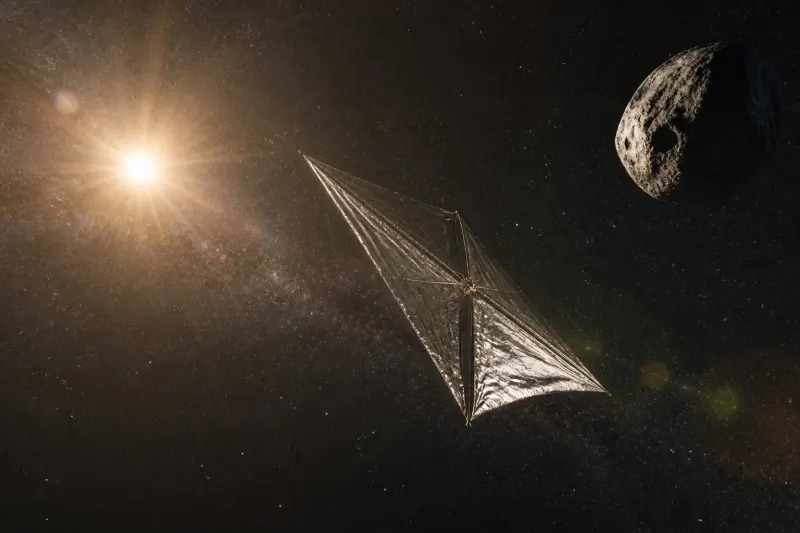
Researchers at Beihang University propose a novel alternative using a diffractive solar sail to tackle the threat of asteroids head-on. This new approach allows a spacecraft to impact an incoming asteroid at speeds around 100 km/s — a dramatic increase compared to the DART mission. By approaching from the opposite direction, the impactor could transfer up to 230 times more energy per kilogram than DART, making it a powerful tool for asteroid deflection.
The Engineering Challenge
One of the primary challenges of this approach is achieving a retrograde orbit, where the spacecraft travels against the natural orbital direction of planets. Traditional chemical rockets struggle with this due to the constraints of Tsiolkovsky’s rocket equation, which limits how much fuel they can carry. In contrast, solar sails operate by harnessing the pressure exerted by sunlight. Using a solar sail means that a spacecraft could maneuver more effectively into a counter-orbital path without being limited by fuel capacity.
Understanding Solar Sails
Solar sails work by utilizing solar radiation pressure, converting sunlight into thrust. The technology has been demonstrated in space with missions such as the JAXA's IKAROS and The Planetary Society's LightSail 2, which successfully tested traditional reflective sails. However, pulling off the H-reversal trajectory requires a refined approach due to the awkwardness of traditional sails, which reflect sunlight at a constant angle and limit efficiency when maneuvering.
Diffractive Solar Sails: A New Frontier
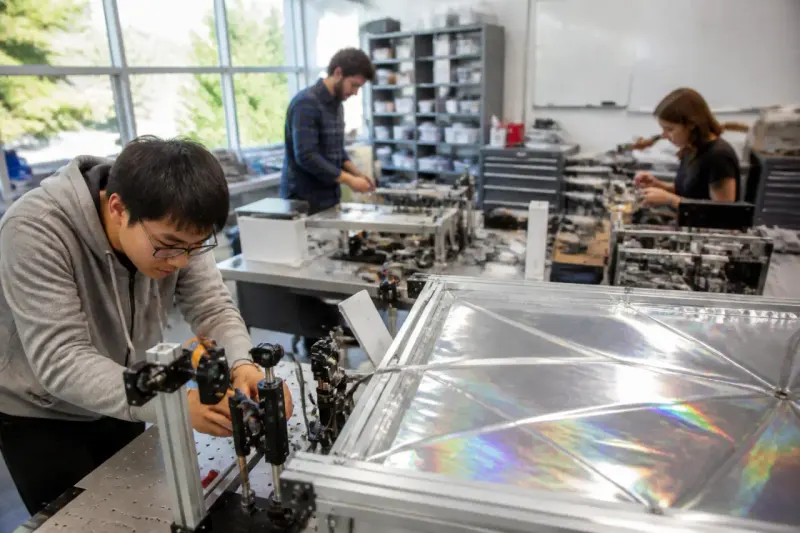
Enter the diffractive solar sail, a cutting-edge design utilizing microstructured optical gratings that diffract light sideways. This innovation allows the sail to maintain a wide surface area facing the Sun while simultaneously generating significant thrust. With this design, spacecraft can better maintain control over their angle, essential for executing the H-reversal trajectory necessary for an impact at high velocity.
Simulations and Results
Researchers conducted simulations with multiple solar sail configurations and concluded that diffractive reflective sails proved to be the most effective option for achieving a successful H-reversal trajectory. In their tests, this configuration was the only one that did not collapse into the Sun or become ejected from the solar system entirely. These simulations demonstrated the incredible potential of this technology in deflecting asteroids, confirming the viability of this method.
Targeting Apophis: A Case Study
The researchers also explored how diffractive solar sails might be employed against the well-documented asteroid Apophis, a 340-meter-wide object expected to come remarkably close to Earth on April 13, 2029, passing within just 38,000 km. Although a deflection is not immediately warranted for this approach, simulating the capability of deploying a diffractive sail against such an asteroid served as a valuable experiment. The simulations indicated that, regardless of configuration, a diffractive sail could deliver a 100 km/s impactor to Apophis within approximately 200 to 300 days after launch.
Frequently Asked Questions