
Samsung Galaxy S26 FE vs. Galaxy S25 FE: Key Differences Explained
A detailed comparison of the Samsung Galaxy S26 FE and Galaxy S25 FE highlights the key differences in design, performance, camera capabilities, and pricing.
Introduction
The latest Samsung Galaxy S26 FE has officially launched, inviting comparisons with its predecessor, the Galaxy S25 FE. For those considering the new model, it’s essential to weigh the differences, especially given the price increase for the S26 FE. While the latest iteration features updates mainly in the chipset, prospective buyers must ask if the upgrades justify the additional cost.
Design Comparison
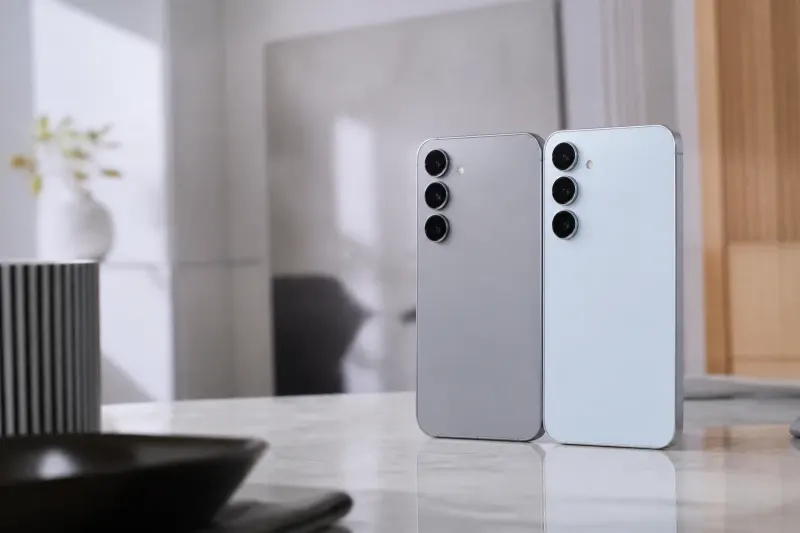
Both the Galaxy S26 FE and Galaxy S25 FE exhibit similar dimensions and design aesthetics. The S26 FE weighs 193 grams and measures 161.6 x 76.9 x 7.4 mm, while the S25 FE is slightly lighter at 190 grams with dimensions of 161.3 x 76.6 x 7.4 mm. This difference is negligible in day-to-day use. Furthermore, both devices maintain a premium build quality featuring Gorilla Glass Victus+ and "Enhanced Armor Aluminum" for the side frame.
In terms of color options, the S26 FE offers three new colors: Blueberry, Graphite, and Pistachio, while the S25 FE came in four options: Icyblue, Jetblack, Navy, and White. Although color may slightly influence buyer preference, it's unlikely to be a primary deciding factor.
Display Features
The 6.7-inch OLED display remains a highlight for both models, featuring a resolution of 1080 x 2340 pixels and a refresh rate of 120Hz. The display’s pixel density is the same across both models at 385 ppi, with the S26 FE achieving a peak brightness of 1268 nits, compared to the S25 FE’s 1247 nits. While these differences are minimal, they do contribute to an overall slightly enhanced viewing experience with the S26 FE.
Battery Comparison
| Model | Battery Capacity | Charging Speed | 15 Min Charge | 30 Min Charge | Full Charge Time |
|---|---|---|---|---|---|
| Samsung Galaxy S26 FE | 4900 mAh | 45W | 40% | 69% | 68 min |
| Samsung Galaxy S25 FE | 4900 mAh | 45W | 36% | 63% | 70 min |
Despite sharing the same battery capacity, the S26 FE showcases improved efficiency, largely attributed to its Exynos 2500 SoC. This new chip enhances web browsing and video streaming capabilities, resulting in better battery endurance in real-world usage. Charging speeds are also marginally improved, with the S26 FE being 4 percentage points faster at the 15-minute mark and 6 percentage points faster at 30 minutes; however, the full charge time only shows a 2-minute difference.
Speaker and Audio Quality
In terms of audio, both models utilize a stereo loudspeaker setup that remains consistent between iterations. Although alterations were made, the S25 FE produces slightly louder audio. However, the differences are subtle and may not be distinguishable to most users during regular use.
Performance Benchmarking
The S26 FE is powered by the Exynos 2500, a chip built on a 3 nm process, while the S25 FE utilizes an older Exynos 2400 built on a 4 nm process. This year-on-year advancement offers noticeable improvements in both performance and energy efficiency, reflected in benchmark scores:
- AnTuTu: S26 FE - 102,119, S25 FE - 101,748
- Geekbench (Single-Core): S26 FE - 68,035, S25 FE - 66,948
- 3D Mark Wild Life: S26 FE - 5,275, S25 FE - 4,226
Despite the measurable differences, the average user may not find them compelling unless utilizing the device for gaming or demanding applications. Both devices retain a standard offering of 8GB RAM and options for 128GB, 256GB, and 512GB of internal storage.
Camera Specifications and Performance
Camerawise, both models feature identical hardware, using a 50MP main sensor and 8MP telephoto lens alongside a 12MP ultrawide. This continuity brings into question the upgrade’s value, as there are no new sensor technologies in the S26 FE. Nevertheless, image quality does show slight variations in different lighting conditions.
In daylight scenarios, both devices produce similar outcomes, with noticeable improvements in the S26 FE's photo clarity thanks to refined image processing. However, at low-light performance, the S25 FE may occasionally yield preferable contrast, with its images appearing more vibrant compared to the S26 FE's sometimes washed-out results.
Night mode performance, especially with telephoto shots, is critically important for users. The S26 FE has shown to reduce noise levels more effectively in many instances, yet the S25 FE remains strong, especially in overall detail retention. Selfies also present similarly high-quality outcomes, affirming that photo quality should not significantly factor into the decision for many customers.
Software and Upgrade Path
Both phones promise up to 7 years of major OS upgrades. However, consumers should note that since the S25 FE launched earlier, its upgrade support will conclude a year sooner than that of the S26 FE despite both devices running the latest software versions upon release.
Key Takeaways
- The Galaxy S26 FE offers a better chipset with improved performance and battery longevity.
- Charging speed improvements are marginal but present, making the S26 FE slightly more efficient.
- Camera hardware remains unchanged between both models, with very similar performance across different lighting conditions.
- Upgrading to the S26 FE provides an extra year of OS support compared to the S25 FE.
- The price difference is approximately €50 or $100 depending on the market; buyers may prefer the S25 FE for better value considering feature parity.
Conclusion
While the Galaxy S26 FE provides some updated features, such as a more powerful chipset and slightly enhanced battery life, many other aspects — including design, camera performance, and even charging speeds — remain largely the same as those seen in the S25 FE. For users who prioritize having the latest software support and a marginal performance edge, the S26 FE may justify its higher price. However, for those seeking cost-effective functionality, the S25 FE presents a compelling argument as the more economical choice.
Frequently Asked Questions