
Trump and Tech CEOs Sign Accord for AI Self-Regulation
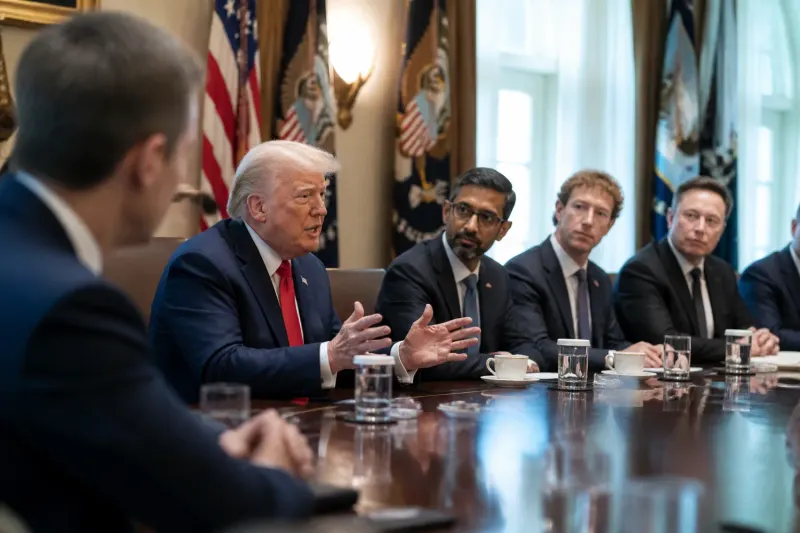
President Trump declared at the White House that a new voluntary accord for self-regulation in AI development was signed by major tech executives, aiming to mitigate public concerns.
Background of the AI Accord
On September 29, 2026, President Donald Trump announced a significant step forward in the realm of artificial intelligence regulation during a press conference at the White House. Alongside CEO leaders from top AI firms, he declared the signing of a voluntary accord designed to foster self-regulation within the industry. Trump stated that this accord emphasizes the necessity of internal and external reviews as a response to public concerns surrounding AI technology.
Key Participants in the Accord
The accord has significant backing from influential figures in the tech sector, including:
- Dario Amodei - CEO of Anthropic
- Sundar Pichai - CEO of Google
- Mark Zuckerberg - CEO of Meta
- Greg Brockman - President of OpenAI
- Jensen Huang - CEO of Nvidia
- Elon Musk - Founder of xAI, which is now part of SpaceX
Voluntary Steps in the Accord
The accord lays out several key components meant to address AI risks while enabling innovation:
- Implementation of robust internal controls by AI companies.
- Engagement with an independent external auditor to evaluate the effectiveness of these controls.
- Establishment of a committee within each company’s board of directors to review reports from both internal and external auditors.
Future Regulation Considerations
The agreement includes language that suggests that, over time, these voluntary measures could evolve into formal regulations. President Trump indicated that further discussions about regulatory needs would follow, mentioning plans to identify individuals who could oversee this accord.
Economic Impact of AI Development
During the press briefing, Trump extolled the economic benefits that AI technology is bringing to the United States. He specifically mentioned that the investment associated with building out AI infrastructures, including data centers, contributes to notable economic growth and boosts the stock market. This dynamic has enriched higher-income Americans and is expected to augment their spending capabilities.
Industry Concerns and Skepticism
While the accord aims to bolster safety measures, not all industry voices are enthusiastic. Dario Amodei underscored the inherent risks linked with AI technology, emphasizing that how these risks are mitigated remains a vital conversation within the sector. Robin Jia, a professor at the University of Southern California, expressed concerns that self-policing may not adequately align with public interests. She highlighted the need for ensuring that the intentions of leading AI firms genuinely reflect the broader public good, especially in light of recent hacking incidents and increasing technological capabilities.

The Role of AI in Governance
In a related development, President Trump unveiled a new AI chatbot — America.gov — designed to assist citizens in navigating government services. This initiative was spotlighted as part of a larger daylong event celebrating what Trump refers to as a "Golden Age" for AI. He underlined, "We can’t stifle it, and we’re leading by a lot," as he discussed the chatbot's potential to streamline processes, such as applying for passports entirely online, without requiring in-person visits.
Community Engagement and Data Centers
Trump also addressed ongoing grassroots opposition to the establishment of data centers in local communities across the U.S. He asserted that tech executives have pledged to address these concerns by offering financial support to local education institutions and taking actionable steps to alleviate energy costs associated with these facilities. He predicted that enhanced community relations would lead to increased acceptance of data centers, stating, "You’re going to see, data centers are going to be very popular." He cautioned that failure to win over local populations could result in tech companies seeking overseas alternatives for their operations.
Concluding Remarks on Global AI Dynamics
The dialogue around AI extends beyond the U.S. borders, as Trump emphasized the global competition between the United States and China. He articulated that this competition would yield a definitive winner, stating, "There’s no seconds." Recently, both nations agreed to establish a channel to manage AI-related incidents. Still, Trump emphasized a cautious approach to collaboration with China, asserting, "Why would I want to do anything?" due to what he perceived as America's leading position in AI innovation.
Key Takeaways
- President Trump announced a voluntary AI self-regulation accord with major tech firms.
- The accord includes steps such as internal controls and external audits.
- Concerns among experts regarding the efficacy of self-policing remain prominent.
- Trump highlighted the economic benefits of AI development, particularly at local levels.
- Future regulation may evolve from the measures outlined in the accord.
Frequently Asked Questions