

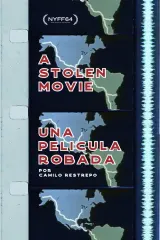
Synopsis
Camilo Restrepo's 12-minute experimental short reappropriates a 1960s General Motors promotional film that documented a Chevrolet Corvair expedition crossing the Darién Gap — the dense, roadless jungle separating Colombia from Panama. Through remix and juxtaposition, Restrepo draws a line between that corporate-sponsored conquest of terrain and the present-day reality of migrants traversing the same gap on foot, fleeing violence and poverty toward an uncertain north.
The film uses the original footage's triumphant narration and images of industrial might as ironic counterpoint to the unseen human cost of borders, both then and now. No talking heads, no interviews — only archival manipulation and sound design to argue that the gap between capital's mobility and people's immobility is a designed condition, not a natural one.
A Stolen Movie: Archival Remix as Political Intervention
At just 12 minutes, A Stolen Movie arrives as a concentrated dose of essayistic cinema — Camilo Restrepo's latest excavation of how corporate propaganda and colonial infrastructure intertwine. The Colombian director, known for Los Conductos and Cilaos, reappropriates a 1960s General Motors promotional film documenting a Chevrolet Corvair caravan crossing the Darién Gap, that lawless jungle choke point between Colombia and Panama. Restrepo's strategy is familiar in experimental circles: take the master's tools, dismantle the master's house. But compression is a double-edged sword; the runtime barely allows the parallel between mid-century industrial conquest and contemporary migrant trails to breathe.
Form Over Fluency
Restrepo's remix aesthetic — layering, looping, ironic juxtaposition — recalls Chris Marker or Harun Farocki, yet the film's brevity forces a didacticism that longer works avoid. The GM footage, all gleaming chrome and paternalist narration, is potent raw material: American engineering "taming" a landscape that has swallowed centuries of extractive ambition. When Restrepo cuts to present-day migrants navigating the same terrain on foot, the visual rhyme is immediate and damning. But without space for counterpoint or ambiguity, the critique risks becoming a caption rather than a conversation. The sound design, a sparse collage of engine hum and jungle noise, does heavy lifting, yet one wonders what a 40-minute version might have unearthed — testimonies, archival digressions, the Corvair's own fatal flaws as metaphor.
Who Is This For?
Festival programmers and students of visual culture will recognize the lineage: Dawson City: Frozen Time meets The Pearl Button. General audiences expecting a conventional documentary on the Darién crisis will find only fragments. That's not a failure — it's a choice. But the choice carries weight when the subject is human suffering rendered as montage. Restrepo's politics are unimpeachable; his faith in the image's self-evidence, less so. A Stolen Movie is a provocation, not a portrait. Whether provocation suffices depends on what you bring to the screening.
Pros
- Inventive reappropriation of corporate propaganda footage
- Potent visual parallel between 1960s industrial conquest and modern migration
- Restrepo's precise, essayistic editing creates immediate political resonance
- Sound design effectively bridges temporal layers
- Compact runtime makes it accessible for classroom or festival programming
Cons
- 12-minute runtime compresses complex history into didactic shorthand
- No migrant voices or perspectives — only the filmmaker's montage
- Relies on viewer's prior knowledge of Darién Gap politics
- Irony-heavy approach risks aestheticizing suffering
- Feels like a proof-of-concept for a longer, richer work
Verdict
A Stolen Movie is a sharp, if schematic, archival intervention that makes its point efficiently but leaves deeper excavation for the viewer to pursue. Worth seeing for its formal audacity and political clarity; frustrating for its refusal to linger.
Reader Rating
Be the first to rate this movie
Write a Review
Sign in to share what you thought — star ratings above need no account.
Frequently Asked
What is A Stolen Movie about?
A Stolen Movie is a 12-minute experimental short by Colombian director Camilo Restrepo that remixes a 1960s General Motors promotional film about a Chevrolet Corvair crossing of the Darién Gap, drawing parallels to contemporary migrant journeys through the same terrain.
Is A Stolen Movie worth watching?
If you're interested in experimental documentary, archival cinema, or Latin American political filmmaking, yes — it's a concise, formally sharp intervention. General audiences seeking a conventional migration documentary may find it too fragmentary.
How long is A Stolen Movie?
The film runs 12 minutes.
Who directed A Stolen Movie?
Camilo Restrepo, a Colombian filmmaker known for experimental works like Los Conductos and Cilaos.
Is A Stolen Movie suitable for kids?
The film contains no graphic content but deals with mature political themes (migration, colonialism, corporate power) through abstract montage. It's best suited for teens and up with contextual guidance.
If you liked this, watch
Movie data provided by TMDB. This product uses the TMDB API but is not endorsed or certified by TMDB.