

Top Cast






Trailer
Synopsis
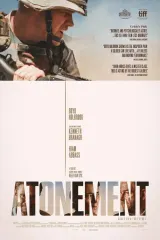
Marine Lu Lobello (Boyd Holbrook) returns from a 2006 Baghdad raid haunted by the possibility that his unit killed an innocent Iraqi family. Years later, consumed by guilt, he tracks down Nora (Gheed), the family’s sole survivor, hoping to make amends. As their uneasy connection deepens, the film examines the long shadow of moral injury and the elusive nature of forgiveness.
Set against the backdrop of the Iraq War and its aftermath, Atonement follows Lobello’s fragmented memories and his strained reintegration into civilian life, while a journalist (Kenneth Branagh) documents his quest. The story unfolds through a non-linear structure that blurs past and present, forcing both characters and audience to confront the ambiguity of memory and responsibility.
Atonement: A Fractured Reckoning with the Past
Reed Van Dyk’s Atonement arrives as a sober, character-driven war drama that trades battlefield spectacle for the quiet erosion of a soldier’s conscience. Based on Dexter Filkins’ New Yorker article, the film follows Marine Lu Lobello (Boyd Holbrook), a man haunted by a 2006 Baghdad raid that left an Iraqi family dead. Years later, guilt drives him to seek out Nora (Gheed), the sole survivor, in a bid for absolution that feels less like redemption and more like an excavation of wounds that refuse to close.
Direction and Atmosphere
Van Dyk, who also wrote the screenplay, adopts a restrained visual language. The Iraq sequences are grainy, disorienting, and deliberately fragmented — mirroring Lobello’s fractured memory. Stateside, the palette cools into sterile blues and grays, emphasizing isolation. This contrast works, but the pacing occasionally stalls; long silences that aim for contemplation sometimes read as indecision. The director’s refusal to offer easy moral signposts is admirable, yet the film’s ambiguity can feel like a crutch rather than a deliberate choice.
Performances
Holbrook carries the film with a raw, internalized performance. He conveys Lobello’s torment through micro-expressions — a clenched jaw, averted eyes — rather than grand monologues. Hiam Abbass, as Mariam Khachaturian, brings quiet authority to her limited screen time, embodying a grief that transcends language. Kenneth Branagh, as Michael Reid, a journalist who becomes Lobello’s confidant, adds gravitas but feels underutilized; his character serves more as a narrative conduit than a fully realized presence. The Iraqi cast, particularly Gheed as Nora, delivers affecting work, though the script rarely grants them interiority beyond their relation to the protagonist’s guilt.
Story and Themes
The central premise — a perpetrator confronting a survivor — is potent, and the film wisely avoids a tidy reconciliation. However, the narrative leans heavily on familiar tropes: the haunted veteran, the investigative journalist, the spectral flashback. The adaptation struggles to translate the article’s journalistic density into cinematic momentum. Themes of moral injury, cultural disconnect, and the limits of atonement are raised but not always explored with the nuance they demand. The third act’s climax, while emotionally charged, resolves in a manner that may feel either profoundly honest or frustratingly opaque, depending on the viewer’s tolerance for open endings.
Who Will Appreciate This Film
Atonement will resonate with audiences who favor meditative, character-first war films over action-oriented ones. Viewers who appreciated The Hurt Locker’s psychological focus or In the Valley of Elah’s moral complexity will find common ground here. Those expecting a conventional redemption arc or clear political statement may leave unsatisfied. It’s a film that asks more than it answers — a quality that can be either its greatest strength or its most maddening flaw.
Pros
- Boyd Holbrook’s nuanced, physically committed lead performance
- Atmospheric cinematography that distinguishes timelines effectively
- Thoughtful exploration of moral injury without easy answers
- Kenneth Branagh’s steady, authoritative supporting turn
- Sound design that immerses the viewer in the protagonist’s disorientation
Cons
- Uneven pacing that sometimes mistakes slowness for depth
- Heavy-handed visual symbolism (recurring motifs of water, mirrors)
- Iraqi characters remain largely defined by their victimhood
- Narrative ambiguity that occasionally feels like avoidance
- Underdeveloped secondary characters, especially the journalist arc
Verdict
Atonement is a well-acted, morally ambitious war drama that occasionally stumbles under the weight of its own restraint. It’s worth watching for Holbrook’s performance and its refusal to simplify trauma, but its pacing and narrative opacity may test patience.
Reader Rating
Be the first to rate this movie
Write a Review
Sign in to share what you thought — star ratings above need no account.
Frequently Asked
Is Atonement worth watching?
If you appreciate slow-burn, character-driven war dramas that prioritize psychological depth over action, yes. Holbrook’s performance and the film’s moral complexity reward patient viewers, but those seeking a clear narrative payoff may find it frustrating.
What is Atonement about?
A Marine haunted by a deadly 2006 Baghdad raid seeks out the sole surviving member of an Iraqi family he believes his unit harmed, confronting guilt, memory, and the limits of redemption.
Is Atonement suitable for kids?
No. The film deals with mature themes of war trauma, guilt, and violence, and contains intense emotional content unsuitable for children.
Does Atonement have a happy ending?
The ending is deliberately ambiguous and open to interpretation, avoiding a conventional happy or tragic resolution in favor of moral complexity.
Is Atonement based on a true story?
Yes, it is adapted from Dexter Filkins’ New Yorker article about Marine Lu Lobello’s real-life experience and subsequent attempt to reach out to an Iraqi family.
If you liked this, watch
Movie data provided by TMDB. This product uses the TMDB API but is not endorsed or certified by TMDB.