

Top Cast
Synopsis
European archival footage from the 1950s documents Sahrawi children and nomadic youth in Western Sahara. Seventy years later, a group of young people from Laayoune revisit the same coastal, desert, and oasis locations that may appear in that footage. As they move from ocean to desert to oasis under starlit skies, they share reflections on their lives, dreams, and visions of utopia, creating a dialogue across time between the photographed past and the living present.
The film weaves together the grainy black-and-white archives with contemporary color cinematography, letting the young participants speak for themselves without narration or explicit historical framing. Their conversations touch on identity, displacement, and the search for an "uncertain upstream" — a metaphor for origins and futures both obscured by colonial history and ongoing geopolitical tension.
Between Us and the World: A Ghostly Dialogue Across Time
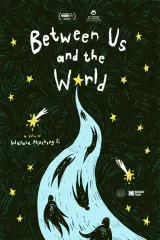
Wallace Minchong Li's Between Us and the World arrives as a 17-minute theatrical documentary that feels more like a prose poem than a conventional film. The premise is arresting: European archival footage from the 1950s captured Sahrawi children and nomadic youth in Western Sahara; seven decades later, young people from Laayoune return to those same coastal, desert, and oasis locations to speak about life, dreams, and utopia under trembling starlight. It's a ghost story where the ghosts are alive and the haunting is mutual.
Direction and Visual Approach
Li's direction favors atmosphere over exposition. The archival material — grainy, silent, colonial in origin — is not merely illustrated but interrogated. Contemporary footage mirrors its compositions: a child running on the beach then, a teenager pausing at the same shoreline now; a camel caravan crossing dunes then, a motorbike kicking up sand now. The parallels are deliberate, sometimes heavy-handed. The film's brevity forces compression; we get fragments of testimony rather than portraits. The "uncertain upstream" of the tagline remains poetic but narratively opaque. Cinematography by Li himself (uncredited in the facts but evident) captures the harsh beauty of the landscape with a patient eye, though the starlight sequences occasionally veer into aestheticization that risks romanticizing the very history the film seeks to unsettle.
Performances and Presence
The cast — Saad Eddine Boujemal, Abderrahman El Achhab, Badr Eddine Rachidi, Amira Boujemal, Ruby, Marwa Fasla, Hassouna Mohamed Amine, Fadali Cheikh Malaynine, Aya Iffa, Alaaeddine Lazar — are not actors but locals. Their presence carries the weight of lived reality. They speak in Arabic, Hassaniya, and French, subtitled in English. Some deliver lines with the self-consciousness of non-professionals; others achieve a raw immediacy that trained performers might struggle to match. The film wisely avoids talking-head interviews, instead letting conversations unfold during walks, around fires, in moving vehicles. Yet the short runtime means we never learn enough about any individual to anchor the collective meditation. They function more as a chorus than characters.
Who Should Watch
This is not a documentary for viewers seeking historical context, political analysis, or clear narrative arcs. It belongs to the lineage of experimental ethnography — think The Act of Killing meets Nanook of the North reimagined by the subjects themselves. Festival programmers, students of postcolonial cinema, and audiences drawn to poetic nonfiction will find it provocative. General audiences may find it frustratingly elliptical. At 17 minutes, it plays more like an installation piece than a theatrical feature; its ideal venue might be a gallery loop rather than a cinema seat.
Pros
- Innovative structure juxtaposing colonial archives with contemporary self-representation
- Stunning cinematography capturing Western Sahara's varied landscapes
- Authentic voices of Sahrawi youth rarely centered in Western cinema
- Poetic refusal of didactic explanation respects audience intelligence
Cons
- Extreme brevity (17 minutes) prevents meaningful character development or historical context
- Elliptical approach may alienate viewers unfamiliar with Sahrawi history
- Aestheticization of starlight/desert imagery occasionally undermines political urgency
- No clear narrative throughline — functions better as installation than theatrical film
Verdict
A visually striking but frustratingly brief poetic documentary that succeeds more as a provocation than a portrait. Its 17-minute runtime feels like a fragment of a larger, necessary conversation — beautiful in moments, incomplete as a whole.
Reader Rating
Be the first to rate this movie
Write a Review
Sign in to share what you thought — star ratings above need no account.
Frequently Asked
Is Between Us and the World worth watching?
If you appreciate experimental documentaries and poetic nonfiction, yes — it's visually arresting and conceptually bold. If you prefer clear narratives or historical exposition, you may find it too fragmentary.
What is Between Us and the World about?
Sahrawi youth from Laayoune revisit locations filmed in 1950s European archival footage, reflecting on life, dreams, and utopia while creating a dialogue between colonial-era images and their present reality.
How long is Between Us and the World?
17 minutes — it's a short documentary, not a feature-length film.
Is Between Us and the World suitable for kids?
It contains no graphic content but deals with complex themes of colonialism, displacement, and cultural identity that may require adult context for younger viewers.
Where was Between Us and the World filmed?
Western Sahara (including Laayoune/El Aaiún), Morocco, and the United Kingdom — moving from ocean to desert to oasis locations.
If you liked this, watch
Movie data provided by TMDB. This product uses the TMDB API but is not endorsed or certified by TMDB.