

Top Cast


Synopsis
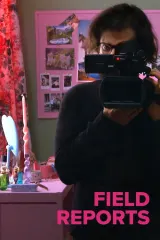
An autistic documentary filmmaker (Jon Beaton) spends a day recording the domestic routines of a neurotypical couple, Sarah (Alma Rio Cromstege) and Tom (Lander Merckx). Through his lens, their shared language, unconscious gestures, and easy physical intimacy become unfamiliar rituals to be cataloged — objects passed without looking, jokes completed mid-sentence, silence filled without awkwardness.
As afternoon stretches toward evening, the filmmaker's presence shifts from passive observer to something more complicated. The distance he maintains begins to feel less like methodology and more like exclusion, and the film's final moments linger on the gap between studying a world and belonging to it.
Field Reports Review: A Brief, Inverted Lens on Neurotypical Ritual
At just eight minutes, Field Reports functions less like a conventional short film and more like a concentrated thought experiment. Writer-director-star Jon Beaton casts himself as an autistic documentarian who turns the clinical gaze usually reserved for neurodivergent subjects onto a neurotypical couple, Sarah (Alma Rio Cromstege) and Tom (Lander Merckx). The premise is clever — reversing the power dynamic of observation — but the micro-runtime forces a choice between sketch and study, and the film lands somewhere in between.
Direction and Concept
Beaton's direction is deliberately clinical: static frames, lingering close-ups on objects (a coffee mug, a phone screen, the space between bodies on a couch), and a soundscape that amplifies mundane noises — chewing, typing, the hum of a refrigerator. This formal rigor mirrors the protagonist's analytical detachment, and for the first half it works as both character insight and audience immersion. But the approach also flattens Sarah and Tom into specimens rather than people. We learn their rhythms but not their interiority, which may be the point — the filmmaker can't access it — yet it leaves the drama feeling schematic rather than felt.
Performances
Beaton's lead performance is restrained to the point of opacity; his filmmaker speaks little, observes much, and the alienation the synopsis promises arrives mostly through his growing stillness. Cromstege and Merckx have the trickier task: performing "neurotypical" as an unfamiliar culture. They nail the shorthand — overlapping dialogue, assumed context, touch as punctuation — but the script gives them no moments off-script, no cracks in the performance. They're convincing as a unit, less so as individuals.
Who Will Connect
Viewers interested in neurodivergent perspectives on social performance, or in formalist shorts that treat cinema as anthropology, will find Field Reports provocative. Those expecting narrative payoff, emotional arcs, or even a clear thesis may feel the film ends exactly when it should be starting. At eight minutes, it's a calling card — for Beaton's voice, for a feature expansion, for a conversation about who gets to observe whom. Whether it satisfies as a standalone piece depends entirely on what you bring to it.
Pros
- Inventive reversal of the neurotypical gaze onto neurotypical subjects
- Disciplined formal control — sound design and framing serve the concept
- Performances capture the uncanny familiarity of everyday social choreography
- Provokes conversation about observation, empathy, and who defines 'normal'
- Efficient runtime respects the viewer's time
Cons
- Eight minutes is insufficient to develop characters beyond types
- Sarah and Tom remain specimens rather than people
- Alienation arc is stated more than felt
- Feels like a proof-of-concept for a longer work
- Limited emotional entry point for viewers not already invested in the framework
Verdict
Field Reports is a formally precise, conceptually sharp micro-short that succeeds better as a provocation than a complete story. Its eight-minute runtime is both its discipline and its limitation — worth watching for the perspective flip, but don't expect resolution.
Reader Rating
Be the first to rate this movie
Write a Review
Sign in to share what you thought — star ratings above need no account.
Frequently Asked
Is Field Reports worth watching?
If you're interested in neurodivergent perspectives, experimental shorts, or films about social performance, yes — it's a concise, thought-provoking eight minutes. If you prefer narrative closure or character depth, it may feel slight.
What is Field Reports about?
An autistic filmmaker documents a neurotypical couple's daily routines, treating their intuitive communication and shared rituals as an anthropological subject. The film explores the gap between observing social behavior and participating in it.
How long is Field Reports?
The film runs exactly 8 minutes.
Is Field Reports suitable for kids?
The film carries an AL certification (all ages) and contains no objectionable content, but its abstract, observational style and themes of social alienation may not engage younger viewers.
Who directed Field Reports?
Jon Beaton directed, wrote, and stars as the documentary filmmaker.
If you liked this, watch
Movie data provided by TMDB. This product uses the TMDB API but is not endorsed or certified by TMDB.