

Top Cast



Trailer
Synopsis
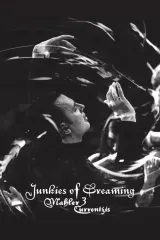
During rehearsals for Mahler's sprawling Third Symphony at Berlin's historic House of Radio, conductor Teodor Currentzis drives his orchestra through a process that blurs the line between artistic creation and ritual possession. Director Jan Schmidt-Garre captures the rehearsals with unflinching closeness, juxtaposing the conductor's volcanic intensity with the quiet resilience of contralto Wiebke Lehmkuhl and the spectral presence of the GDR-era venue itself.
As the symphony's six movements unfold across the rehearsal period, the film explores what Mahler's 130-year-old score demands of modern performers — and what the act of collective music-making reveals about devotion, control, and the search for transcendence.
Junkies of Dreaming Review: Mahler, Currentzis, and the Architecture of Obsession
Jan Schmidt-Garre's Junkies of Dreaming arrives as a 90-minute documentary that refuses the conventional talking-head format, instead embedding itself inside the pressure cooker of Teodor Currentzis rehearsing Mahler's Third Symphony at the historic House of Radio in Berlin. The film's central tension isn't whether the performance will succeed — it's whether the camera can survive the intensity of a conductor who treats every rehearsal as an existential crisis.
Direction: Intimacy as Invasion
Schmidt-Garre, a veteran of music documentaries (Pianomania, The Sound of Cologne), employs a strategy of radical proximity. His camera doesn't observe Currentzis; it hunts him. We see the conductor's fingers twitching at a phrase, the sweat on his neck, the way he stops an entire orchestra to reshape a single breath. The House of Radio itself — a GDR-era relic with its own ghosts — becomes a character, its cold modernist corridors contrasting with the volcanic emotional demands of Mahler's score. Yet this intimacy has a cost: the film rarely pulls back to provide historical or biographical context. We learn what Currentzis does, but rarely why he does it, leaving his mythos both amplified and oddly opaque.
Performances: The Conductor and the Contralto
Teodor Currentzis dominates the frame with the charisma of a cult leader and the precision of a surgeon. His rehearsal monologues — half poetry, half provocation — are the film's most electric moments. Wiebke Lehmkuhl, as the contralto soloist, provides a necessary counterweight: grounded, vulnerable, visibly negotiating the abyss between Currentzis's demands and her own instrument. The "young couple in love" referenced in promotional materials appears only glancingly, a metaphorical thread rather than a narrative one. Their presence feels more like a directorial flourish than an integrated perspective, a reminder that Junkies of Dreaming is less about human stories than about the sublimation of self into art.
Who Will Endure the 90 Minutes?
This is not a documentary for the Mahler-curious; it's for the Mahler-obsessed. Viewers fluent in orchestral mechanics will find the rehearsal sequences revelatory — a masterclass in how a symphony gets built, measure by agonizing measure. General audiences may find the hermetic intensity alienating, the lack of explanatory scaffolding frustrating. The film assumes you already know why the Third Symphony matters, and why Currentzis's interpretation matters. If you don't, you're left admiring the architecture without a blueprint.
Pros
- Unprecedented access to Currentzis's rehearsal process
- Striking cinematography that makes the House of Radio a character
- Wiebke Lehmkuhl provides a human anchor amid the abstraction
- Mahler's Third Symphony serves as a magnificent structural spine
- Avoids documentary clichés — no talking heads, no explanatory narration
Cons
- Assumes deep prior knowledge of Mahler and Currentzis
- The "young couple" narrative thread feels decorative, not integrated
- Pacing mirrors rehearsal tedium — intentionally, but taxingly
- No historical or biographical context for Currentzis's methods
- May feel pretentious to viewers outside the classical world
Verdict
A viscerally filmed but hermetically sealed portrait of artistic obsession that will entrance classical devotees and likely alienate everyone else. Schmidt-Garre captures the heat of creation but refuses to open a window for the uninitiated.
Reader Rating
Be the first to rate this movie
Write a Review
Sign in to share what you thought — star ratings above need no account.
Frequently Asked
Is Junkies of Dreaming worth watching?
If you love classical music documentaries or are fascinated by the rehearsal process of a major conductor, yes. General audiences may find it impenetrable.
What is Junkies of Dreaming about?
The film documents conductor Teodor Currentzis rehearsing Mahler's Third Symphony with an orchestra at Berlin's historic House of Radio, focusing on the intensity of artistic preparation.
Is Junkies of Dreaming suitable for kids?
There's no objectionable content, but the subject matter and pacing make it inappropriate for children. Best for teens and adults with classical music interest.
How long is Junkies of Dreaming?
The film runs 90 minutes.
Who directed Junkies of Dreaming?
Jan Schmidt-Garre, a German filmmaker known for music documentaries including Pianomania (2009) and The Sound of Cologne (2019).
If you liked this, watch
Movie data provided by TMDB. This product uses the TMDB API but is not endorsed or certified by TMDB.