

Top Cast


Trailer
Synopsis
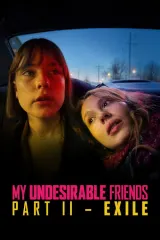
Picking up after the events of Part I, My Undesirable Friends: Part II - Exile tracks a network of Russian independent journalists forced to flee their country following the 2022 invasion of Ukraine. Dispersed across Georgia, Latvia, Germany, and other nations, they attempt to sustain their outlets, protect their sources, and maintain editorial independence while navigating asylum bureaucracy, financial precarity, and the psychological toll of displacement.
Director Julia Loktev adopts a fly-on-the-wall approach, foregoing narration or retrospective interviews in favor of real-time documentation. The film captures newsroom meetings held over Signal, late-night debates about editorial lines, and quiet moments of homesickness — building a portrait of professional resilience that is as much about logistics as ideology.
My Undesirable Friends: Part II - Exile Review: A Marathon of Witness
Julia Loktev's My Undesirable Friends: Part II - Exile demands something increasingly rare in modern viewing: patience. At 355 minutes — nearly six hours — this documentary doesn't just ask for your attention; it requires a scheduling commitment. The film follows a cohort of Russian independent journalists scattered across Europe and beyond after the 2022 invasion of Ukraine, picking up where Part I left off in Moscow's tightening vise. Loktev, who directs and writes, eschews talking-head interviews for something closer to embedded anthropology. We see Anna Nemzer, Valeria Ratnikova, Ksenia Mironova, and their colleagues not as symbols but as people navigating visa queues, time-zone disorientation, and the peculiar grief of watching your homeland from the outside.
The Weight of Witness
The film's greatest strength is also its most taxing quality: accumulation. Loktev lets scenes breathe — sometimes past comfort. A conversation about encrypted messaging drags into silences; a birthday dinner in Tbilisi stretches until the alcohol thins the professional veneer. These choices honor the subjects' lived reality, where resistance isn't dramatic confrontations but the daily grind of filing copy, securing funding, and keeping sources safe. The ensemble cast (all credited as "Self") carries this naturalism effortlessly. Elena Kostyuchenko's dry wit and Nataliya Gumenyuk's steely composure emerge organically, never performative. Yet the runtime tests even sympathetic viewers. By hour four, the observational rigor begins to feel like endurance rather than immersion. One wonders what a tighter, three-hour cut might have sacrificed — and whether the answer justifies the bloat.
Who Should Watch
This is not an entry point. Without Part I's context, the web of relationships and institutional histories remains opaque. For viewers who've followed the first installment, or who track press freedom in post-Soviet spaces closely, Exile offers an invaluable, unvarnished record. Casual documentary fans will likely tap out. Loktev trusts her audience to do the editorial work of finding meaning in the mundane — a bold stance, but one that assumes a very specific viewer.
Pros
- Unflinching observational intimacy with its subjects
- Rare, ground-level documentation of press freedom in real time
- Strong ensemble presence from the journalist-participants
- Avoids heroic mythologizing in favor of mundane endurance
Cons
- 355-minute runtime tests endurance without clear structural justification
- Largely inaccessible without viewing Part I first
- Observational purity sometimes drifts into aimlessness
- Limited contextual framing for viewers unfamiliar with Russian media landscape
Verdict
An ambitious, uncompromising chronicle of journalistic exile that respects its subjects by refusing to simplify their reality — but its near-six-hour runtime demands a level of commitment that will limit its audience to the already converted.
Reader Rating
Be the first to rate this movie
Write a Review
Sign in to share what you thought — star ratings above need no account.
Frequently Asked
Is My Undesirable Friends: Part II - Exile worth watching?
If you have seen Part I and care deeply about press freedom or contemporary Russian politics, yes — it's a vital, unvarnished record. For general audiences, the near-six-hour runtime and assumed context make it a difficult recommendation.
What is My Undesirable Friends: Part II - Exile about?
The film follows Russian independent journalists who fled abroad after the 2022 invasion of Ukraine, documenting their efforts to continue reporting from exile while navigating displacement, funding crises, and the emotional toll of separation from home.
Do I need to watch Part I before Part II?
Strongly recommended. Part II assumes familiarity with the journalists, their outlets, and the political pressures established in the first film. Without it, relationships and stakes remain opaque.
Is My Undesirable Friends: Part II - Exile suitable for kids?
No. The film deals with mature political themes, displacement trauma, and contains unfiltered conversations among adults in high-stress situations. It carries no official certification but is intended for adult audiences.
How long is My Undesirable Friends: Part II - Exile?
355 minutes — approximately 5 hours and 55 minutes. It is an exceptionally long documentary, best approached as a multi-session viewing experience.
If you liked this, watch
Movie data provided by TMDB. This product uses the TMDB API but is not endorsed or certified by TMDB.