

Top Cast
Synopsis
An isolated gamer stumbles upon a mysterious analog-style game that promises deep, anonymous human connection through a screen. Intrigued by the prospect of genuine interaction, they engage with the unknown player on the other end — only to realize the game's mechanics are built on something far darker than code.
As the session progresses, the boundary between player and played blurs, revealing a system designed not for connection but for something far more disturbing. The short runtime compresses the descent into a single, tense encounter with the unknown.
Nine Days of Sadness: A Micro-Budget Horror Experiment
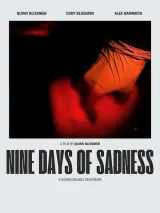
Nine Days of Sadness arrives as a 13-minute theatrical short written, directed, and co-starred by Quinn Blissmer — a one-person creative engine that immediately signals both ambition and constraint. The premise hooks you: an isolated gamer finds an analog-style game promising anonymous human connection, only to uncover the rot beneath. It's a concept ripe for analog-horror treatment, the kind that thrives on CRT static, distorted audio, and the uncanny valley of early internet intimacy. But at 13 minutes, the film barely has time to breathe, let alone build the slow dread its premise demands.
Direction and Concept
Blissmer's direction shows a clear affection for the analog horror aesthetic — scanlines, tracking errors, the tactile menace of floppy disks and cathode rays. The tagline "A DOWNLOADABLE NIGHTMARE" promises a digital curse, and the visual language delivers that texture in flashes. However, the runtime forces exposition into corners where atmosphere should live. The "game" mechanics remain vague; the connection between players feels asserted rather than experienced. A feature-length version could mine this territory for existential paranoia — think Coherence meets The Den — but the short format reduces a potentially layered mystery to a checklist of creepy beats. The mystery genre tag suggests puzzle-box storytelling, yet the pieces don't have room to click.
Performances and Execution
With a cast of three (one voice-only), the weight falls on Blissmer as Inquirer #13 and Cody Blissmer as Colby/Inquirer #12. Both turn in committed, naturalistic work that grounds the surreal premise. Alex Hammock's voice-only Hiker adds a layer of weary authenticity. The problem isn't the acting — it's the script's refusal to let anyone exist beyond function. Characters are ciphers for plot progression, denied the quiet moments that make horror personal. Technically, the film wears its micro-budget visibly: sound design carries more weight than image, and the analog effects, while effective in isolation, repeat without evolution. The drama genre tag implies emotional stakes, but 13 minutes permits only sketching, not earning.
Who Will Appreciate This
Analog horror devotees and short-film completists will find flavor here — the specific nostalgia of corrupted data, the loneliness of early online spaces. Festival programmers scouting raw talent might note Blissmer's ability to stretch minimal resources. General horror audiences, however, should temper expectations: this is a proof-of-concept masquerading as a finished film. The audience score remains unknown, and without a wider sample, it's impossible to gauge whether the concept resonates beyond the niche. If you treat it as a calling card for a feature expansion, it succeeds. As a standalone narrative, it's a ghost of a story — present in atmosphere, absent in substance.
Pros
- Strong analog horror aesthetic with effective CRT/glitch textures
- Committed naturalistic performances from a micro-cast
- Intriguing high-concept premise about digital intimacy and exploitation
- Clear directorial voice despite extreme budget constraints
Cons
- 13-minute runtime severely undercuts character and mystery development
- Script reduces characters to plot functions, denying emotional stakes
- Analog effects repeat without evolution or escalation
- Feels like a proof-of-concept rather than a complete narrative
- Sound design carries disproportionate weight over visual storytelling
Verdict
Nine Days of Sadness shows a filmmaker with a sharp eye for analog horror texture but not enough runtime to turn premise into payoff. Worth a watch for genre completists; others may find it more frustrating than frightening.
Reader Rating
Be the first to rate this movie
Write a Review
Sign in to share what you thought — star ratings above need no account.
Frequently Asked
Is Nine Days of Sadness worth watching?
If you enjoy analog horror aesthetics and micro-budget experimentation, yes — it's a concise 13-minute mood piece. General horror viewers may find it too slight for a satisfying experience.
What is Nine Days of Sadness about?
An isolated gamer discovers an analog-style game promising anonymous human connection, only to uncover the horrific system powering it. The film explores digital intimacy, exploitation, and the uncanny nature of early internet spaces.
Is Nine Days of Sadness suitable for kids?
No. The film carries horror, mystery, and drama genres with disturbing themes about exploitation and psychological horror. No official certification is listed, but the content is intended for mature audiences.
How long is Nine Days of Sadness?
The film runs 13 minutes — a theatrical short, not a feature-length movie.
Who directed Nine Days of Sadness?
Quinn Blissmer wrote, directed, and stars in the film as Inquirer #13, making it a largely solo creative effort alongside co-stars Cody Blissmer and Alex Hammock.
If you liked this, watch
Movie data provided by TMDB. This product uses the TMDB API but is not endorsed or certified by TMDB.