

Top Cast
Yukihiro Miyamoto
Director

Aoi Yuuki
Madoka Kaname (voice)

Chiwa Saito
Homura Akemi (voice)

Kaori Mizuhashi
Mami Tomoe (voice)

Eri Kitamura
Sayaka Miki (voice)

Ai Nonaka
Kyoko Sakura (voice)

Kana Asumi
Nagisa Momoe (voice)

Emiri Kato
Kyubey (voice)

Shion Wakayama
Shichōka (voice)

Tomoyo Kurosawa
Selma Therese (voice)
Synopsis
After Homura Akemi rewrote the universe to shield Madoka Kaname, a tenuous equilibrium settles over the world. But a new manifestation of the legendary witch Walpurgisnacht begins to stir, threatening to unravel the fragile peace. Homura must confront the consequences of her godlike choice, rally her former allies — Mami, Sayaka, Kyoko, and the mysterious newcomers Shichōka and Selma Therese — and decide how far she will go to protect the girl she loves, even if it means sacrificing everything she has built.
The film follows Homura’s desperate struggle as the boundaries between hope and despair blur, leading to a climactic confrontation that tests the very nature of miracles and the price of eternal guardianship.
Puella Magi Madoka Magica the Movie -Walpurgisnacht: Rising- Review
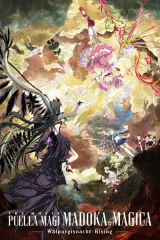
Puella Magi Madoka Magica the Movie -Walpurgisnacht: Rising- arrives as the long‑awaited sequel to Rebellion, promising to resolve the fragile peace left after Homura’s universe‑rewriting gambit. Director Yukihiro Miyamoto returns alongside series architect Gen Urobuchi, and the film leans heavily on the visual language that made the franchise a modern classic: stark color contrasts, surreal labyrinth designs, and a soundscape that oscillates between haunting choral motifs and frantic electronic pulses.
Direction and Visual Storytelling
Miyamoto’s direction is confident but occasionally indulgent. The opening act re‑establishes the new status quo with meticulous world‑building, yet the pacing drags during the extended exposition sequences that revisit familiar magical‑girl mechanics. When the Walpurgisnacht threat finally materializes, the action set pieces explode with kinetic energy — each battle feels like a living painting, and the integration of 3D background elements with traditional 2D animation is seamless. However, the film’s reliance on abstract symbolism sometimes obscures narrative clarity, leaving viewers to piece together emotional beats from visual cues rather than dialogue.
Performances
The returning voice cast delivers the expected emotional weight. Aoi Yuuki’s Madoka retains a fragile optimism that contrasts sharply with Chiwa Saito’s Homura, whose performance deepens into a weary determination tinged with self‑loathing. Kaori Mizuhashi, Eri Kitamura, and Ai Nonaka reprise Mami, Sayaka, and Kyoko with nuanced maturity, while newcomers Shion Wakayama (Shichōka) and Tomoyo Kurosawa (Selma Therese) add fresh layers without feeling shoehorned. Emiri Kato’s Kyubey remains chillingly detached, serving as the series’ moral compass — or lack thereof.
Story and Themes
At its core, the script wrestles with the cost of protection and the ethics of rewriting reality. The narrative threads introduced in Rebellion — Homura’s self‑imposed godhood, the ambiguous nature of the “new world,” and the lingering threat of Walpurgisnacht — converge in a climax that is both spectacular and philosophically dense. Yet the film occasionally over‑explains its metaphysics, sacrificing the ambiguous dread that made the original series resonate. The resolution offers a bittersweet closure for longtime fans, but newcomers may find the dense lore impenetrable without prior viewing.
Who Will Enjoy It
Devotees of the Madoka franchise will appreciate the meticulous continuity, the visual ambition, and the emotional payoff for characters they’ve followed for over a decade. Viewers seeking a standalone magical‑girl story, however, should watch the preceding TV series and Rebellion first; the film assumes intimate familiarity with its mythology. Casual anime fans may admire the artistry but could feel alienated by the heavy exposition and abstract finale.
Pros
- Gorgeous, surreal animation that pushes the franchise’s visual identity forward
- Strong voice performances deepening beloved characters
- Ambitious exploration of sacrifice, agency, and the cost of protection
- Satisfying emotional closure for the core cast
Cons
- Pacing drags during heavy exposition segments
- Abstract symbolism sometimes obscures narrative clarity
- Requires thorough knowledge of the TV series and Rebellion to fully appreciate
- Over‑explanation of metaphysical concepts reduces the series’ signature ambiguity
Verdict
A visually stunning, thematically ambitious continuation that rewards longtime fans but may overwhelm newcomers with its dense lore and occasional pacing issues.
Reader Rating
Be the first to rate this movie
Write a Review
Sign in to share what you thought — star ratings above need no account.
Frequently Asked
Is Puella Magi Madoka Magica the Movie -Walpurgisnacht: Rising- worth watching?
If you have followed the Madoka series through Rebellion, the film offers a visually spectacular and emotionally resonant conclusion. New viewers should watch the prior entries first, as the story assumes deep familiarity.
What is Puella Magi Madoka Magica the Movie -Walpurgisnacht: Rising- about?
The movie continues after Rebellion, where Homura’s rewritten world faces a new Walpurgisnacht threat. Homura must confront the fallout of her choices and decide how far she will go to protect Madoka.
Is Puella Magi Madoka Magica the Movie -Walpurgisnacht: Rising- suitable for kids?
The film contains dark themes, psychological horror elements, and intense violence typical of the franchise. It is rated for mature audiences and not recommended for young children.
Do I need to watch the TV series before this movie?
Yes. The narrative builds directly on events from the 12‑episode series and the Rebellion film; skipping them will leave major plot points and character motivations incomprehensible.
Who are the new characters Shichōka and Selma Therese?
Shichōka (voiced by Shion Wakayama) and Selma Therese (voiced by Tomoyo Kurosawa) are original characters introduced in this film, expanding the magical‑girl roster and adding fresh dynamics to the final conflict.
If you liked this, watch
Movie data provided by TMDB. This product uses the TMDB API but is not endorsed or certified by TMDB.