
Top Cast
Trailer
Synopsis
In a stark black-and-white world, a sinister showman named M. Balm operates a traveling moving-picture exhibition that secretly transforms its young audience into hollow-eyed ghouls. Gladys Bradbury, a lone woman immune to the machine's influence, infiltrates the screening to dismantle the projector and end the cycle of corruption.
The film unfolds almost entirely within the confines of the makeshift cinema, blending expressionistic visuals with a metaphor about media's power to devour innocence.
Revenge of the Celluloid: Direction and Atmosphere
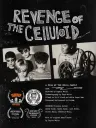
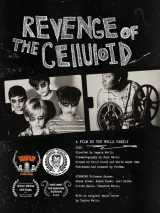
Revenge of the Celluloid arrives as a six-minute horror experiment that wears its influences on its sleeve. Director Angela Wells chooses a strict monochrome palette, evoking the silent-era expressionism of The Cabinet of Dr. Caligari while framing the narrative as a cursed film screening. The decision to shoot in black and white is the short's strongest asset; high-contrast lighting carves the embalmer's laboratory into deep shadows and stark highlights, creating a tactile sense of dread that belies the micro-budget production. Practical effects — latex prosthetics, viscous fluids, and the jerky movements of the ghouls — are photographed with a gritty affection that horror purists will appreciate. However, the visual ambition occasionally outpaces the technical execution: some compositions suffer from soft focus, and a few digital artifacts betray the low-resolution capture.
Sound and Score
The soundscape leans heavily on a droning, industrial ambient track punctuated by the whir of a projector and wet, organic squelches. It's effective in small doses but becomes repetitive across the brief runtime. Dialogue recording is uneven; Princess Garner's lines as Gladys Bradbury are clear, while Derek Brown's M. Balm occasionally disappears into the mix, robbing the villain of some menace.
Performances
Garner carries the film with a grounded, watchful presence. Her Gladys is less a final girl than a determined investigator, and she sells the character's resolve without melodrama. The ensemble of ghouls — played by Theodore Wells, Oliver Wells, Kaden Brown, and Levi Brown — commit fully to physical performance, moving with a puppet-like uncanniness that suits the premise. Brown's M. Balm is theatrical in the tradition of classic mad scientists, but the script gives him little more than exposition to deliver, leaving the character more archetype than personality.
Story and Pacing
The premise — a generative machine disguised as a moving picture show that transforms children into mindless ghouls — is rich with metaphorical potential (media consumption as literal consumption). Yet the six-minute container forces ruthless compression. Backstory is conveyed through title cards and hurried dialogue, leaving the mechanics of the "cinema of horrors" vague. The climax arrives abruptly, and the resolution feels more like a stop point than a conclusion. For a short film, narrative economy is expected, but here the ideas outstrip the screentime, resulting in a trailer for a feature that doesn't exist.
Who Should Watch
Fans of experimental horror, silent-cinema homage, and practical-effects showcases will find much to admire. Viewers seeking character depth, coherent world-building, or a satisfying scare arc may feel shortchanged. As a calling card for Angela Wells' visual sensibility, it succeeds; as a standalone story, it remains a fragment.
Pros
- Striking monochrome cinematography with genuine expressionist flair
- Committed practical effects and physical performances from the ghoul ensemble
- Princess Garner delivers a compelling, understated lead performance
- Inventive core concept — cinema as literal soul-consuming machine
- Concise runtime respects the viewer's time
Cons
- Severe narrative compression leaves premise under-explored
- Uneven audio recording undermines key villain moments
- Character development sacrificed for atmosphere
- Abrupt ending feels like a proof-of-concept rather than a finished story
- Digital artifacts occasionally break the analog illusion
Verdict
Revenge of the Celluloid is a visually striking but narratively incomplete horror short that demonstrates strong directorial voice while buckling under its own ambition. Worth a watch for genre enthusiasts curious about micro-budget ingenuity, but unlikely to linger in memory.
Reader Rating
Be the first to rate this movie
Write a Review
Sign in to share what you thought — star ratings above need no account.
Frequently Asked
Is Revenge of the Celluloid worth watching?
If you appreciate experimental horror shorts, silent-film aesthetics, and practical effects, yes. If you prefer fully realized narratives with character arcs, you may find it frustratingly slight.
What is Revenge of the Celluloid about?
A mad embalmer uses a cursed film projector to turn children into ghouls; one woman attempts to destroy the machine and stop him.
Is Revenge of the Celluloid suitable for kids?
No. Despite its short length, it contains body horror, disturbing imagery, and thematic darkness inappropriate for children.
How long is Revenge of the Celluloid?
The film runs exactly six minutes.
Where can I watch Revenge of the Celluloid?
As a 2026 indie short, festival screenings and niche streaming platforms are the most likely avenues; no wide theatrical or major streaming release has been announced.
If you liked this, watch
Movie data provided by TMDB. This product uses the TMDB API but is not endorsed or certified by TMDB.