
3D Printing Revolutionizes Automotive Manufacturing at Ford and Rivian
Discover how leading automakers Ford and Rivian are revolutionizing production through 3D printing, aiming to reduce costs and enhance manufacturing speed.
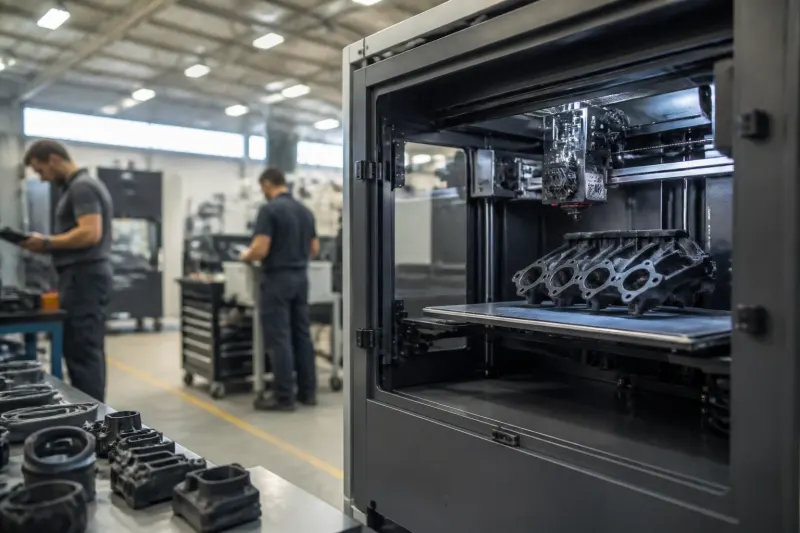
Automakers including Ford, Rivian, and General Motors (GM) are harnessing the potential of 3D printing to streamline manufacturing processes, reduce costs, and speed up production. This technology is transitioning from mere prototyping to becoming a significant component in producing factory tools and some vehicle parts, marking a shift in the automotive industry's approach to manufacturing.
3D Printing's Impact on Manufacturing
Historically used for prototyping, additive manufacturing—or 3D printing—enables manufacturers to create three-dimensional objects from digital designs. This is accomplished by layering materials such as plastics, composites, ceramics, and metals. As automotive manufacturers increasingly invest in this technology, it is being viewed as essential rather than optional.
During a recent overview of its 3D printing operations in suburban Detroit, Jared Beck, head of Rivian's additive manufacturing, emphasized the shift towards widespread adoption within the company: "At this point, we don't have a choice but to scale up and begin using it through all factions of Rivian. We're going to be democratizing 3D printing for the entire company." This reflects a commitment to integrating 3D printing across multiple aspects of the production process.
Investment and Growth in 3D Printing
Rivian has invested over $5 million in acquiring 3D printing machines, with material costs reaching approximately $1.7 million annually. Despite these expenditures, Beck noted, "the machines typically pay for themselves within a year," highlighting the financial viability of this investment. The company has noted significant improvements in speed, reducing production times from weeks to mere days or hours. Rivian's latest expansion also includes adding machines capable of producing flexible silicone parts and establishing a bay for employees to print parts on demand.
Ford's Multifaceted Approach to 3D Printing
Ford employs a different strategy, utilizing additive manufacturing departments across its numerous plants instead of centralized labs. Notably, the company has introduced a vending machine that dispenses 3D-printed parts for the production of its popular F-150 pickups, enabling team leaders to directly access needed components.
Gregory Foresi, a former mechanical engineer at Ford, explained, "By putting the vending machine up, all the team leaders have access. We're able to keep that thing stocked rather than have a bunch of parts laying around in the lab. So that's been pretty huge." This innovation not only enhances the supply chain but also allows for rapid creation of specialized tools designed by employees, which include torque bit sockets, hood jackers, and smoothing tools. Specifically, parts can take anywhere from hours to days to print, depending on complexity.
Moreover, Ford highlighted the utility of 3D printing for maintaining ongoing production. Foresi recalled a scenario where a large machining wheel was necessary to keep an assembly line operational, and 3D printing provided a temporary solution while awaiting a standard supplier's replacement.
GM's Strategic 3D Printing Applications
GM is also leveraging 3D printing extensively, particularly for low-volume products and in research and development. The automaker is using two distinct approaches: integrating 3D printing directly into assembly plants and utilizing the technology for specific vehicle components. GM has recently enhanced its operations by adopting industrial Stratasys printers, which are already in use for producing 135 components for its bespoke Cadillac Celestiq and performance-focused Cadillac Blackwing vehicles.
As highlighted by Fadi Abro, senior global director at Stratasys, GM exemplifies how manufacturers can "standardize and then scale" their 3D printing efforts. Continuous improvements in material properties have led to more extensive use cases, further solidifying 3D printing's role in automotive manufacturing.
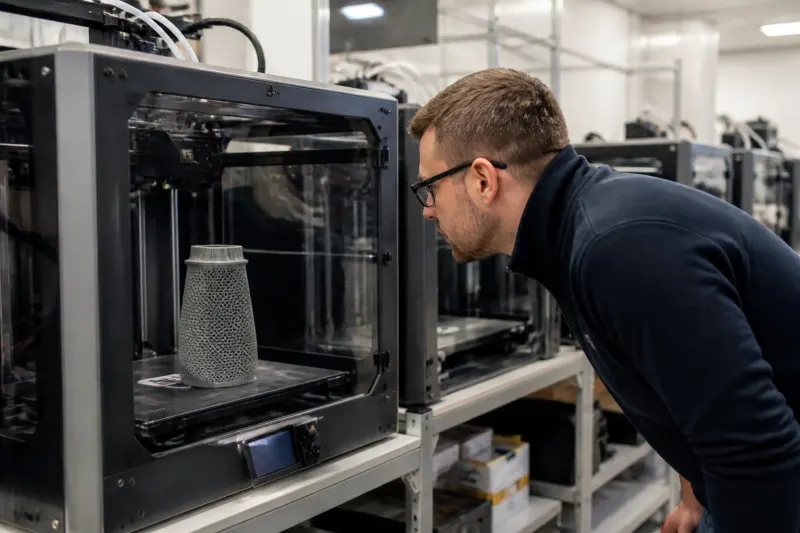
Advantages of 3D Printing in Automotive Manufacturing
The transition to 3D printing offers multiple advantages for automotive manufacturers. Key benefits include:
- Cost Reduction: Decreasing the need for expensive tooling and the costs associated with logistics.
- Speed: Significant reductions in the time taken to produce items—transitioning from weeks to hours.
- Flexibility: The ability to create tailored parts specific to engineering needs promptly.
- Accessibility: Making 3D printing resources widely available to engineers and production teams.
The integration of 3D printing into various stages of manufacturing not only elevates production capabilities but also fosters innovation within the engineering workforce, allowing for rapid adjustments and improvements.
Future of 3D Printing in the Automotive Sector
As automakers like Rivian, Ford, and GM continue to investigate the full potential of 3D printing technology, the automotive industry may see broader implications. The democratization of 3D printing is likely to lead to faster development cycles and more customized vehicle options, ultimately transforming the manufacturing landscape.
Future expansions will likely include more sophisticated printing technologies and larger scale production facilities, which could radically alter the traditional supply chain model prevalent in the automotive sector.
Key Takeaways
- Ford, Rivian, and GM are actively integrating 3D printing into their manufacturing processes.
- Rivian has invested over $5 million in 3D printing technology, with annual material costs of $1.7 million.
- Ford has introduced a vending machine for 3D-printed parts, enhancing access for production teams.
- GM utilizes 3D printing for 135 unique components in their Cadillac models to streamline production and development.
- The use of 3D printing is expected to significantly reduce costs and production times in the automotive industry.
As these companies leverage 3D printing, they stand to reshape the future of automotive manufacturing, driving innovation and efficiency.
Frequently Asked Questions