
CHAPEA Mission 2 Completes 378-Day Mars Simulation
The CHAPEA Mission 2 crew successfully completed their 378-day stay in a simulated Mars habitat, offering insights into future interplanetary missions.

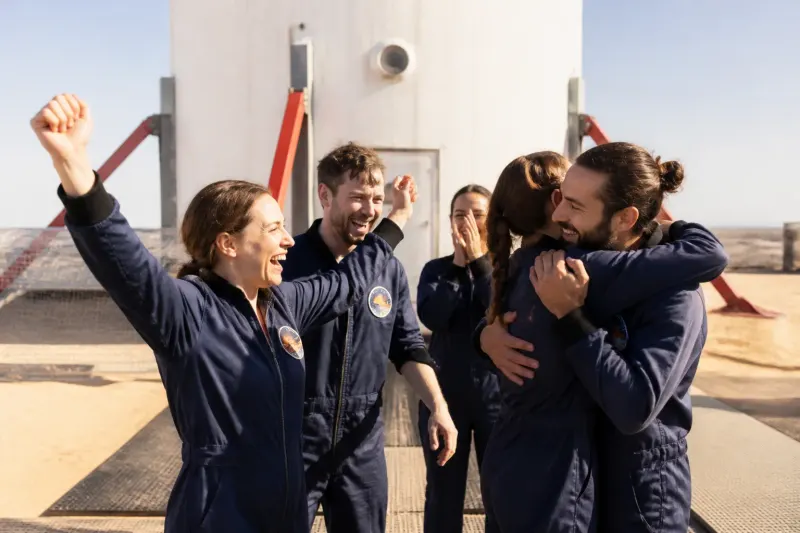
After spending 378 days in isolation, the crew of NASA’s CHAPEA Mission 2 emerged from their simulated Mars habitat on October 31, 2026. The mission, conducted at NASA’s Johnson Space Center in Houston, Texas, served as an essential step in preparing for future crewed explorations beyond Earth.
Mission Overview
The CHAPEA (Crew Health and Performance Exploration Analog) Mission 2 crew comprised four research volunteers: Ross Elder (Commander), Ellen Ellis (Medical Officer), James Spicer (Flight Engineer), and Matthew Montgomery (Science Officer). They entered the roughly 1,700-square-foot and 3D-printed Mars Dune Alpha habitat on October 19, 2025. During their stay, they conducted various activities that simulated the rigors of living on Mars, including:
- Simulated Marswalks
- Robotic operations
- Habitat maintenance
- Crop cultivation
The Experience of Isolation
The crew endured a challenging environment, cut off from the outside world without windows and real-time communication with family and friends. Johnson Space Center Director Vanessa Wyche highlighted the significance of their work, stating, "Their work means more than completing a mission; it is about preparing for the challenges of human exploration beyond Earth, gathering the knowledge we need to protect crew health and performance, paving the way for future missions to the Moon and, one day, Mars."
Reflections from the Crew
Upon exiting the habitat, the crew reflected on their experiences, emphasizing the invaluable lessons learned throughout the mission.
Ross Elder: Commander and Test Pilot
As the mission commander, Ross Elder approached the tasks with the discipline of a U.S. Air Force experimental test pilot. He found the experience of executing simulated Marswalks and robotic exploration operations remarkably similar to flying. Elder noted the importance of physical preparation for long missions and emphasized nutrition, exercise, and rest as vital components for sustaining the team’s performance. He expressed pride in the unity and strength of the crew, stating, "The real magic has been the privilege and pleasure of seeing everyone come together."
Ellen Ellis: Medical Officer and Tactical Thinker
Ellen Ellis focused her medical expertise on optimizing the crew's health and problem-solving abilities. As a U.S. Space Force officer with experience in military operations and engineering, she organized biological sample collections crucial for health research. Ellis described the discipline required to maintain procedures and expressed that the relationships formed with her teammates helped mitigate the isolation. Her key takeaway emphasized the necessity of an integrated ground support team for future missions, saying, "A future Mars crew requires a highly integrated ground team."
James Spicer: Flight Engineer and Systems Specialist
James Spicer, the flight engineer, was integral in maintaining the habitat's systems. He likened the experience to living on a submarine, where resource management from consumables to daily supplies dictated their lifestyle. Surprisingly, Spicer found he missed little from the outside world, attributing this to the focused nature of the mission. He remarked, "We’re inspired every day knowing that the data we’re generating is informing Martian mission planning and increasing the safety, health, performance, and comfort of future Martian crews."
Matthew Montgomery: Science Officer and Versatile Engineer
Matthew Montgomery, known for his broad skill set, embraced tasks ranging from technical problem-solving to agricultural experiments. He pioneered hydroponic techniques for crop cultivation within the habitat, using a seed-germination experiment that tested simulated Martian soil against control samples. Montgomery underscored the collaborative dynamic among the crew, noting that different perspectives led to superior solutions, asserting, "It’s really the people that make exploration possible."
Post-Mission Evaluations and Future Prospects
In the weeks following the crew's egress, evaluations and debriefs will take place, enabling researchers to analyze the collected health and performance data against the crew's experiences. Grace Douglas, CHAPEA’s principal investigator, stated that the research will help NASA better understand human health and performance risks associated with space travel compared to resource allocation, communication capabilities, and sustenance.
These learnings are particularly timely as NASA begins formulating plans for how astronauts will live and work at the first lunar outpost near the Moon’s South Pole. Project scientist Sara Whiting emphasized the relevance of the data collected from this mission and its potential application in shaping the future of human missions to both the Moon and Mars. "This is really the now moment for this kind of data," she remarked.
Key Takeaways
- The CHAPEA Mission 2 crew completed their isolation in the Mars Dune Alpha habitat after 378 days.
- This mission emphasized the importance of health, teamwork, and resource management for future Martian missions.
- The crew's experiences and data will guide NASA in planning for outposts on the Moon and Mars.
- Strong interpersonal relationships and a grounded support team were critical for addressing challenges faced during isolation.
As humanity prepares for the challenges of interplanetary exploration, studies like CHAPEA Mission 2 are paving the way toward a future where missions to Mars and beyond become a reality.
Frequently Asked Questions