
Automakers Brace for Challenges as Costs Rise Heading into 2027
In the face of rising costs and tighter markets, automakers are preparing for a challenging 2027. As pricing power declines and competition rises, industry growth may stall.
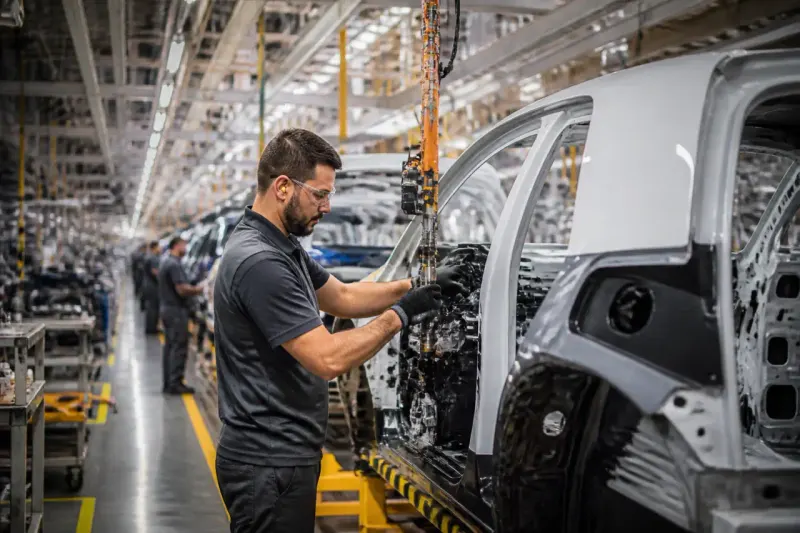
Concerns are mounting in the automotive industry as a perfect storm of rising costs and tight market conditions threatens growth heading into 2027. Despite the resilience shown this past decade, automakers are now voicing fears about inflationary pressures, volatile vehicle pricing, and increased competition, particularly from emerging players in the market.
Challenging Economic Landscape for Automakers
The global automotive industry is facing mounting challenges as it approaches 2027. Industry veterans have noted that many factors are converging that could spell trouble for growth. Costs across multiple sectors—ranging from commodities to logistics—are rising sharply. As pricing power diminishes, consumers may find it increasingly difficult to purchase new vehicles.
According to GlobalData, global light-vehicle production is expected to remain stable in 2027, hovering around 91.65 million units. Analysts have indicated that without strong demand and cost-saving measures, automakers will struggle to maintain earnings.
Pressure from Rising Costs and Inflation
Analysts highlight that automakers must balance rising operational costs with the need for consumer pricing power. Major players are already seeing the impact of this pressure. For example, Ford has projected that its performance in 2027 will mirror that of 2026, while General Motors (GM) is adopting a more cautious outlook regarding its earnings.
GM's CEO, Mary Barra, expressed, “We continue to believe 2027 will be another strong year and better than 2026, assuming customer demand remains strong, and commodity, logistics, and other recent cost pressures moderate.” However, she acknowledged the potential cost headwind of an additional $2 billion due to commodity inflation, logistics costs, and the expenses associated with DRAM (dynamic random-access memory) chips.
Impact of Competition from Chinese Automakers
Adding to the pressure is the growing competition from Chinese automakers who have taken significant market share both domestically and abroad. This competitive landscape, combined with higher production costs and the ongoing fallout from tariffs in the U.S. and Europe, raises questions about the profitability of U.S. automakers. Analysts from RBC Capital Markets have noted that while conditions appear more favorable in the U.S., sentiment in Europe is notably more pessimistic.
Challenges Specific to European Automakers
The scenario is particularly dire for European manufacturers such as Volkswagen, Mercedes-Benz, and BMW. Several leading companies within this region are cutting their earnings forecasts for 2026 amidst rising operating costs, increased competition from Chinese brands, and tariffs imposed by the U.S. government. BMW's recent announcement indicated that restructuring efforts would lead to a 2.5 percentage point reduction in its automotive pretax earnings margin for this year.
Moreover, Stellantis, which operates extensively in both Europe and the U.S., has maintained a mid-single-digit percentage increase in net revenue guidance for 2026 but is likely heading for a low-single-digit adjusted operating margin this year, underscoring the challenges faced in maintaining profit margins.
Performance Outlook for Asian Automakers
Turning to Asia, Hyundai Motor, which has recently enjoyed significant growth, has revised its targets downward. The company reported a reduced wholesales target for 2026, expecting to sell about 4 million vehicles, down from initial projections of 4.16 million. Hyundai has lowered its operating-margin target to between 5.5% and 6.5%, down from a previous range of 6.3% to 7.3%.
Conversely, Toyota stands out with a positive outlook, recently raising its full-year operating income forecast by 500 billion Japanese yen (approximately $3.2 billion) due to favorable currency conditions and robust demand for hybrid vehicles in the U.S.

Consumer Buying Power in Jeopardy
The average price of a new vehicle in the U.S. climbed past $50,500 in September, as per Cox Automotive. Monthly payments also reached a high of $776, the most substantial amount since December 2023. As a result, consumers are financing vehicles at record lengths, leading to concerns that rising prices could price prospective buyers out of the market.
Ongoing Affordability Issues
With the financial strain on many consumers, feedback indicates a potential threat to sales as buyers are becoming increasingly sensitive to vehicle prices. The need for careful management of pricing strategies will be critical moving forward as consumer sentiment appears to be dwindling. Cox Automotive's chief economist noted that there are existing headwinds such as rising costs, interest rates, and elevated fuel prices that are pushing many potential buyers away.
Resilience in Demand for Vehicles
Despite the economic warnings, the demand for vehicles is holding relatively strong. Analysts believe this resilience is visible even as broader economic indicators show cautionary signs. The availability of good credit and solid employment conditions have been seen as positive signs that can offer some reprieve for automakers and consumers alike.
Key Takeaways
- Global light-vehicle production is projected to stay flat at approximately 91.65 million units in 2027.
- Ford expects its results in 2027 to match those of 2026, while GM anticipates additional challenges.
- Rising costs, particularly for commodities and logistics, could impose a $2 billion headwind for GM.
- Chinese automakers pose a growing competitive threat in both domestic and international markets.
- The average U.S. vehicle price has reached over $50,500, raising concerns about consumer affordability.
As the automotive industry navigates these turbulent waters toward 2027, stakeholders will be watching closely. The landscape is set to adapt according to global pressures, while internal strategies will be essential to maintaining growth amid rising costs and increasing competition.
Frequently Asked Questions