
Dead Planets Resurface Around the White Dwarf J1328−1450
Discover the intriguing features of the white dwarf J1328−1450, which harbors a complex double debris disk formed from its orbital planets. Learn how this system mirrors possible future scenarios for our own Solar System.
A Star's Transformation and Aftermath
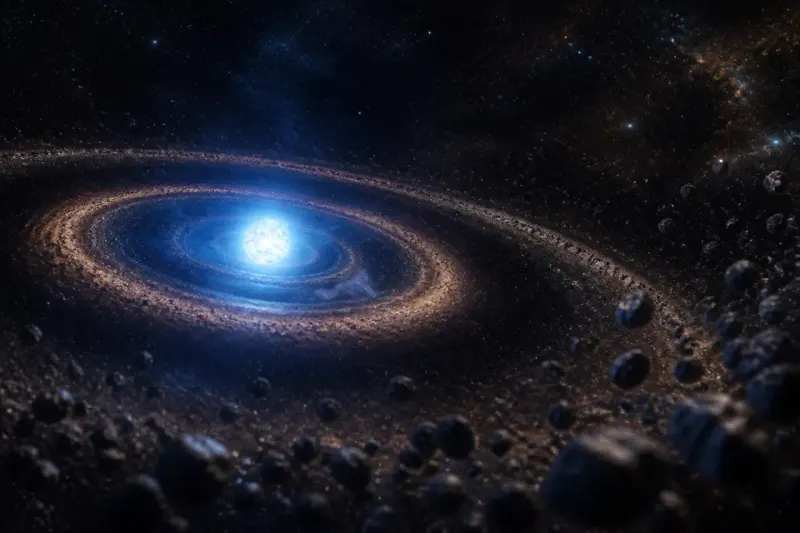
The white dwarf J1328−1450 showcases an intriguing stage in stellar evolution, marking the demise of a once vibrant star. When a star reaches the end of its life, it undergoes a radical transformation, which is distinct according to its mass. In this case, J1328−1450 represents a star that has already moved past the fusion stage, resulting in a stellar remnant where all fusion processes have ceased.
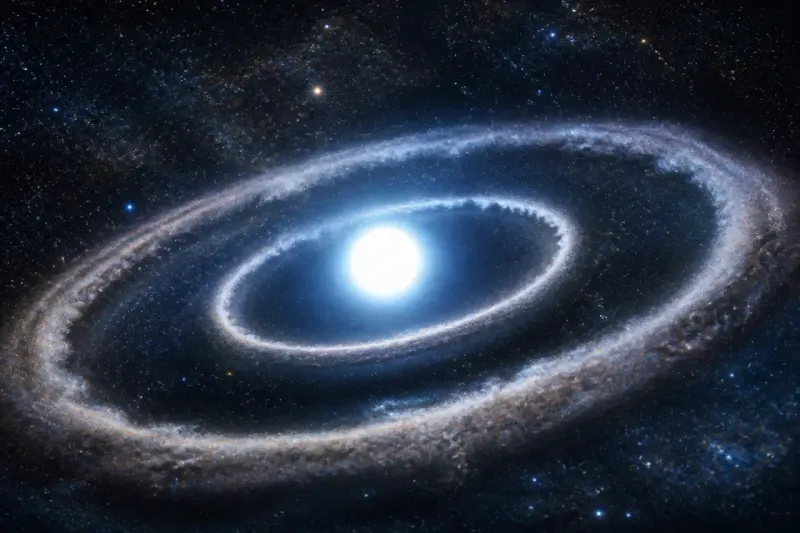
As the star expanded before its death, it obliterated the inner planets that once orbited it, forming a debris disk that now encircles the white dwarf. This disk is not homogeneous; it comprises two concentric rings of gas, each moving at different velocities, and they are separated by a notable gap.
Discovery of a Double Debris Disk
A recent study published in Nature Astronomy titled "A double debris disc around a white dwarf sculpted by two planetary bodies" highlights the discovery of J1328−1450’s double debris disk. Conducted by a team led by astronomer Nicola Gentille Fusillo from the Università degli Studi di Trieste in Italy, this research provides new insights into the complex structures that can form around dead stars.
Gentille Fusillo emphasized the significance of this system, stating, "The system is a rare glimpse of the violent, chaotic process by which a planetary system meets its end, and it hints that dead stars can have disc structures far more complex than previously realised." This reinforces the idea that even in death, a star can create environments where remnants of its past planets may still linger.
Characteristics of the Debris Disk
The debris disk surrounding J1328−1450 has unique features compared to others known in the universe. Most notably, it exhibits double-centered gaseous rings instead of the more common single-ring formats observed in many other white dwarf systems. The research shows that these gaseous rings range significantly in composition and structure.
- The inner ring, which is within a radius of about 0.14 to 0.34 solar radii (R⊙), is noted for being enriched in magnesium.
- The outer ring, extending from approximately 0.54 to 1.93 R⊙, lacks magnesium content, suggesting that these rings may have originated from different sources or stages of planetary development.
Presence of Planetesimals
The formation of these gaseous rings and the overall structure of the disk may be linked to the presence of planetesimals—small planetary bodies that can survive in the debris disk. The behavior of gas in these disks can provide crucial clues about what is happening within.
Typically, the generation of gas is attributed to dust within the disk being vaporized through collisions instigated by planetesimals. If these small bodies collide at sufficient speeds, they could create gas from dust particles, thereby introducing complex dynamics to the environment surrounding the white dwarf.
Gaseous Composition and Density Ranges
Interestingly, the emissions from the gaseous rings exhibit a quadruple-peaked spectral profile, which is a significant difference from the double-peaked emissions typically detected around white dwarfs with debris disks. This quadruple structure suggests varying rotational speeds and possibly different compositions within the disk.
According to the findings, for any planetesimals that continue to exist in these disks, they must possess a substantial degree of internal strength due to the immense gravitational pressures from the nearby white dwarf. The required density for these planetesimals ranges significantly:
| Region | Minimum Density Required |
|---|---|
| Inner Ring | ≥ 3,600 g/cm³ |
| Outer Ring | ≥ 63 g/cm³ |
Planetary Systems and Future Implications
This discovery offers a glimpse into the future of our own Solar System as it evolves over billions of years. As the Sun eventually expands into a red giant and consumes its inner planets, a scene similar to J1328−1450 may unfold. According to co-author Felipe Lagos-Vilches, this research evokes contemplation about what cosmic remnants will exist long after the disappearance of humanity.
There are important implications here for how planetary systems fare as their host stars evolve. While the death of a star could lead to complete destruction of its associated planets, pockets of material may persist and evolve into entirely new formations.
Key Takeaways
- The white dwarf J1328−1450 contains a complex double debris disk.
- Two concentric gas rings show distinct compositions and emission profiles.
- Planetesimals likely play a crucial role in shaping the gas dynamics in the disk.
- The inner gaseous ring is notably rich in magnesium compared to the outer ring.
- The characteristics of this system could parallel the future scenario of our Solar System.
Future Research Directions
The discovery of the stable double debris disk around J1328−1450 presents a new challenge for scientists attempting to understand the long-term processes of debris disk formation and evolution. Observational constraints will aid researchers in constructing more precise models of how these systems behave over time. Continued observations of other white dwarfs may yield additional insights into the universality of these structures.
As astronomers explore similar systems, each finding builds a more comprehensive understanding of stellar life cycles, the fate of planetary systems, and the potential for life beyond our familiar surroundings. The study highlighted here underscores the importance of ongoing research in not just understanding our past but also preparing for what the future may hold in our cosmos.
Frequently Asked Questions