
NASA Partners with SpaceX and Blue Origin for 2028 Moon Missions
NASA collaborates with SpaceX and Blue Origin to expedite lunar lander development ahead of the anticipated 2028 Moon missions, emphasizing operational efficiency and safety.

The ambitious goal of returning American astronauts to the Moon is set for 2028, with NASA collaborating closely with commercial partners SpaceX and Blue Origin. With streamlined designs and evolving operational concepts, both companies are making significant progress on their respective human landing systems as part of the Artemis program.
Lander Operational Overview
| Lander | Operational Approach | Features | Key Objectives |
|---|---|---|---|
| SpaceX Starship | Propellant aggregation in low Earth orbit | Utilizes multiple tanker missions to transfer cryogenic liquid propellant | Docking with Orion in Earth orbit; trans-lunar injection for Moon landing |
| Blue Origin Blue Moon Mark 2 | Three-stage transfer to lunar surface | Built from existing Mark 1 and Mark 2 hardware | Dock with Orion, lunar landing at South Pole |
Accelerating Lunar Landing Development
NASA Administrator Jared Isaacman expressed strong commitment to completing the return of astronauts to the Moon, emphasizing the importance of this mission. He stated, "We have a proven foundation in SLS and Orion, along with two lunar landers in development with Blue Origin and SpaceX. But NASA has no intention of sitting idly by as all the pieces come together." This reflects NASA's proactive and dynamic approach to overcoming challenges associated with lunar exploration.
The Artemis missions focus on sending astronauts aboard the Orion spacecraft, launched on the Space Launch System (SLS) rocket, to conduct significant test operations en route to lunar exploration. In a significant shift to their operational strategies, both SpaceX and Blue Origin will refine their landers' rendezvous methods with Orion, each adapting its orbital mechanics to match its unique design and requirements.
Operational Changes for Efficiency
In a move to enhance mission efficiency, NASA has decided that during initial Artemis crewed missions, rather than rendezvousing in a near-rectilinear halo orbit around the Moon, the landers will link up with the Orion spacecraft in varying orbits tailored to each provider's capabilities. Each company is required to complete uncrewed demonstration missions of their landers prior to crewed missions to ensure both safety and successful operation.
SpaceX's Starship Functionality
SpaceX's Starship is designed with innovative capabilities, featuring an in-space propellant aggregation approach. This involves launching several Starship versions to low Earth orbit to act as propellant tankers, transferring cryogenic propellant to a central depot vehicle. The depot Starship will then fuel the Starship Human Landing System (HLS) for its lunar journey. The revised operational plan shows the Starship HLS will rendezvous and dock with Orion in Earth orbit prior to commencing the trans-lunar injection, allowing for direct access to low lunar orbit. This architectural change is expected to reduce both propellant requirements and the operational timeframe for astronauts returning to Orion from the Moon.
Blue Origin's Blue Moon Capabilities
On the other hand, Blue Origin's approach involves utilizing three transfer stages to send the Mark 2 Blue Moon lander. This design is a departure from prior strategies that involved complicated consultations and transfers. The Mark 2 lander will be launched to low Earth orbit, following which it will perform operations in an elliptical polar orbit, facilitating quicker returns of astronauts from the lunar surface to Orion and minimizing fuel requirements.
With this new operational model, Blue Origin looks to capitalize on information from previous robotic missions conducted as part of NASA's Moon Base Program, preparing for human landings near the Moon's South Pole.
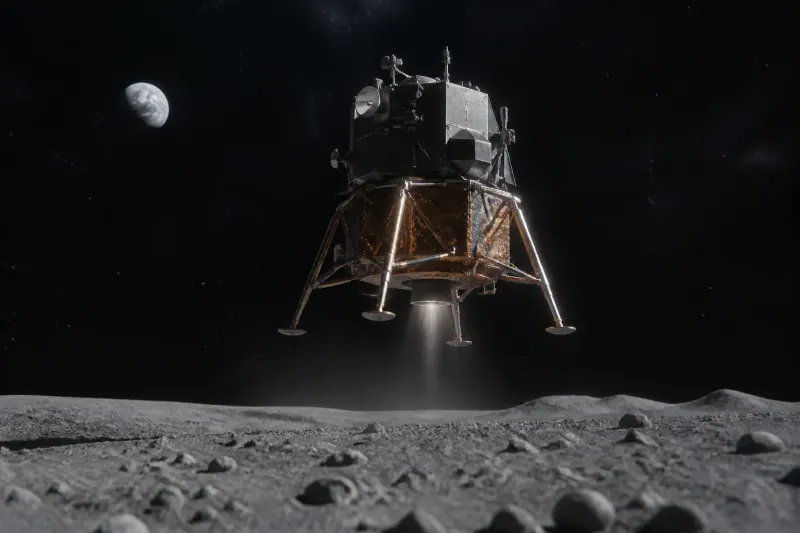
Mission Specifications for Artemis III and Beyond
Navigating through these ambitious plans, Artemis III will serve as a crucial test point. The mission is scheduled for 2027 and aims to evaluate the interoperability of different lunar landers with the Orion spacecraft. The crew will include astronauts Randy Bresnik, Frank Rubio, Andre Douglas, and ESA's Luca Parmitano, who will operate and assess lunar landing technology during a planned fourteen-day mission.
During Artemis III, astronauts will engage in critical system evaluations of both Blue Origin’s and SpaceX’s landers. This twofold evaluation process is designed not just to ensure operational functionality but also to grant NASA critical data on how these systems work in collaboration with Orion, fundamentally preparing ground for the 2028 lunar landing missions.
Future Implications for Lunar Exploration
As NASA builds toward 2028 and the establishment of a Moon base, the agency is simultaneously exploring options for Mars missions. Each Artemis mission is crucial for testing technologies and operational concepts that will be used in the broader scope of lunar support systems, while also advancing our understanding of longer-duration space missions.
Through partnerships with Blue Origin and SpaceX, NASA intends to push boundaries further than ever before, ensuring not only the success of lunar exploration but paving the way for eventual human Mars missions. The agency is preparing for increasingly complex missions, maximizing the partnerships’ contributions to advancing space and aeronautics.
Key Takeaways
- NASA plans to return astronauts to the Moon by 2028, in collaboration with SpaceX and Blue Origin.
- New operational strategies will link landers with Orion in various orbits, enhancing mission efficiency.
- Both lunar landers will undergo uncrewed demonstrations prior to crew missions to ensure safety.
- Artemis III in 2027 will test critical systems for future Moon landings.
- This initiative lays the groundwork for not only lunar bases but also eventual Mars missions.
As preparations intensify for these remarkable feats of exploration, NASA is set to redefine humanity’s presence on the Moon, leading to sustainable lunar exploration and further interplanetary endeavors.
Frequently Asked Questions