
Simons Observatory Launches Mission to Explore Cosmic Microwave Background
The Simons Observatory in the Atacama Desert has launched its mission to survey the Cosmic Microwave Background, aiming to uncover evidence of the Big Bang and cosmic inflation.
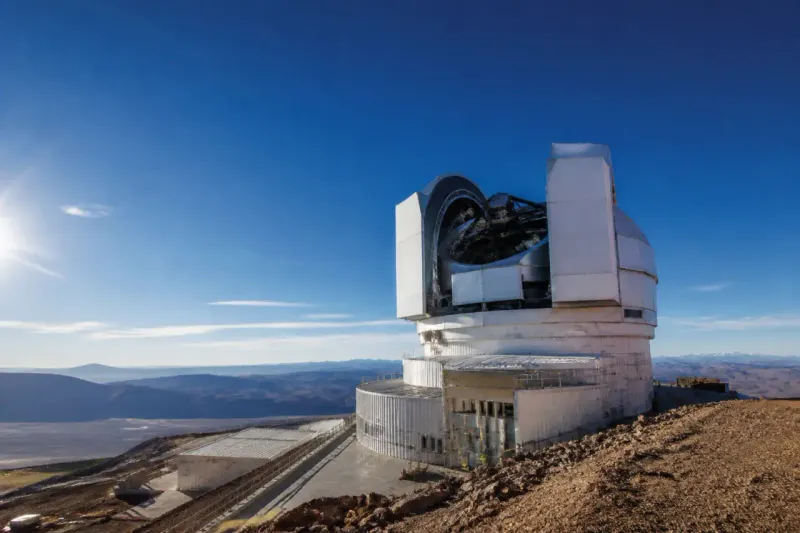
The Simons Observatory (SO) in the Atacama Desert is now operational and set to embark on an ambitious mission to survey the Cosmic Microwave Background (CMB), aiming to uncover evidence of the Big Bang and cosmic inflation. This endeavor seeks to enhance previous findings by leveraging a unique configuration of telescopes to study the universe's earliest light.
The Structure and Purpose of the Simons Observatory
The SO consists of four telescopes: a large 6-meter aperture telescope known as the Large Aperture Telescope (LAT) and three smaller 0.5-meter aperture telescopes in a setup called the Small Aperture Telescope (SAT). This arrangement allows the observatory to achieve a level of detail in the CMB surveys that surpasses earlier efforts made by the Planck satellite.
By combining observations from both large and small telescopes, the SO aims to capture high-resolution images of the CMB, which is the residual radiation from the universe’s first light. Understanding the CMB is crucial as it holds clues about the universe’s formation, particularly during the recombination epoch that occurred roughly 380,000 years after the Big Bang, when the universe became transparent to light.
Technological Advancements in CMB Observations
The observatory boasts nearly 98,000 microwave detectors, a dramatic increase compared to its predecessors. This improved sensitivity is expected to significantly enhance the quality of the data collected, allowing for more precise detection of tiny fluctuations within the CMB that could confirm theoretical models of cosmic inflation and the Big Bang. According to Simons Observatory spokesperson Jo Dunkley, early images from the observatory are already demonstrating less noise and deeper insights compared to historical data collected over longer periods.
The Importance of B-Mode Polarization
A primary goal of the SO is to search for B-mode polarization within the CMB. B-modes are essential indicators that could provide evidence of primordial gravitational waves generated during the inflationary phase of the universe's history. Previous detections of B-modes, most notably by the South Pole Telescope (SPT), raised questions due to uncertainties caused by gravitational lensing that could potentially mask true signals from the early universe.
Simons Observatory's capabilities allow it to distinguish whether observed B-modes are genuine primordial signals or something else entirely, such as artifacts from gravitational lensing. This differentiation is vital because understanding the nature of these waves could bridge gaps between quantum physics and general relativity.
Collaborative Efforts in Cosmic Research
The Simons Observatory doesn’t work in isolation. It is part of a broader network of observatories that includes the SPT and other facilities focused on understanding the CMB. By creating templates that can remove lensing effects, the combined efforts of these various groups could enhance the accuracy of their observations and findings. The synergy among these telescopes signifies a collective scientific endeavor aimed at unlocking fundamental questions about the universe.

Progress and Future Prospects
The observatory has already generated promising initial results, with significant mapping of both the CMB and the Milky Way. Suzanne Staggs, Co-Director of the Simons Observatory, expressed her excitement about the ability to produce detailed maps of cosmic phenomena, stating that the initial data positions them at the forefront of cosmological research.
Looking ahead, plans are underway to expand the observatory's capabilities further. In 2027, three additional SAT telescopes are set to come online, doubling the number of detectors dedicated to mapping the CMB. This enhancement is expected to enrich the observatory's data collection and improve its resolution even further.
Significance for Cosmology and the Future
Ultimately, the SO's mission underscores the growing significance of large-scale astronomical surveys in understanding the universe. With a planned survey extension to 2035, the SO aims to refine its search for the elusive B-mode polarization and contribute to our comprehension of cosmic inflation. Each data release will be made available to the scientific community, bolstering collaborative research in the field.
As the observations begin to stack up, scientists look forward to significant discoveries that could illuminate the very beginnings of our universe. As Staggs points out, the findings from the observatory, combined with data from other surveys like the Vera Rubin Observatory's Legacy Survey of Space and Time, have the potential to revolutionize our understanding of stellar phenomena and the cosmic landscape.
Key Takeaways
- The Simons Observatory has begun its mission to study the Cosmic Microwave Background.
- The observatory integrates a large 6-meter telescope and three smaller telescopes for enhanced data resolution.
- Nearly 98,000 microwave detectors are deployed to capture minute fluctuations in the CMB.
- The search for B-mode polarization is critical for validating theories of cosmic inflation.
- Future expansions in 2027 aim to double the detector count and enhance observational capacity.
With these advances, the Simons Observatory represents a significant step forward in cosmic observation, promising to yield insights that could reshape our understanding of the universe's history and structure.
Frequently Asked Questions