
Canadian Astronaut Joshua Kutryk Conducts First ISS Spacewalk Since 2019
On October 29, 2026, Canadian astronaut Joshua Kutryk will conduct his first spacewalk on the ISS, marking Canada’s first since 2019 and enhancing its power supply.
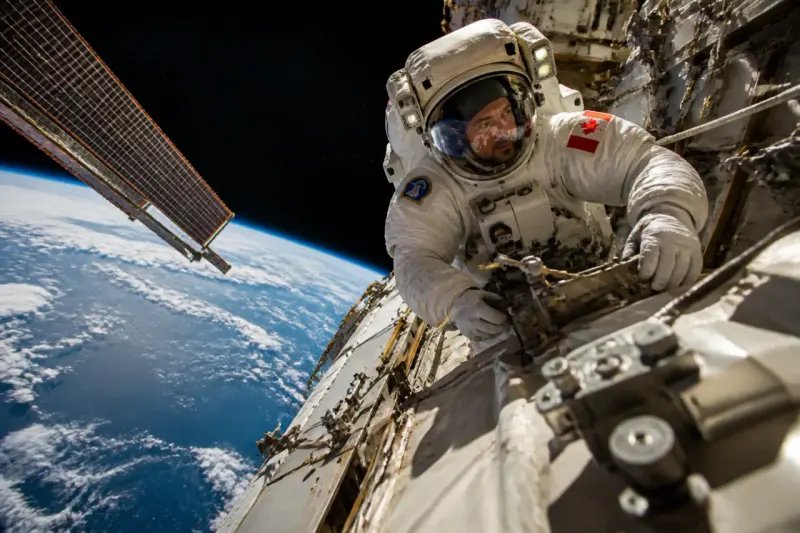
On October 29, 2026, history is being made as Canadian Space Agency (CSA) astronaut Joshua Kutryk embarks on his first spacewalk aboard the International Space Station (ISS). This moment marks a notable milestone as it is Canada's first spacewalk in seven years.
Joined by NASA astronaut Anil Menon, who has previously completed three spacewalks, Kutryk's mission aims to enhance the ISS's power supply by deploying new solar arrays. The scheduled spacewalk will begin at 8 a.m. EDT (1200 GMT) and is expected to last approximately 6 hours and 45 minutes.
The Objectives of the Spacewalk
The primary goal of this spacewalk is to install the seventh and eighth International Space Station Roll-Out Solar Arrays (iROSAs). These solar arrays are designed to be affixed atop the existing solar panels on the ISS, which are beginning to show signs of deterioration from age. The addition of these arrays will contribute to a significant boost in the station’s power generation capability, raising the total from 160 kilowatts to 215 kilowatts, representing an increase of about 30%.
Details of the iROSAs
| Attribute | Specification |
|---|---|
| Length (when deployed) | 20 feet (6 meters) |
| Weight (on Earth) | 750 pounds (340 kilograms) |
| Number of iROSAs to be installed | 2 |
| Current power generation | 160 kilowatts |
| New power generation post-installation | 215 kilowatts |
Expedition and Support Team
Kutryk, alongside Menon, is also backed by an exceptional support team, including Jenni Gibbons, who will serve as the capcom (capsule communicator) for both spacewalks. Gibbons brings valuable experience from her previous mission support roles, including during NASA's Artemis II mission around the moon.
Adding to the technical prowess of the mission is the ISS's robotic arm, Canadarm2, which will facilitate significant aspects of the spacewalk. For instance, it will help maneuver the new solar arrays into place by lifting and positioning them as Kutryk and Menon work outside the station.
The Spacewalk Execution
As they prepare for the spacewalk, Kutryk and Menon will utilize a carefully planned set of maneuvers to manage the deployment of the iROSAs, which includes rotating around the arrays' center of mass to minimize fatigue. NASA's Garrett Hehn, the agency’s spacewalk flight director, explained, “We’ve tried to rotate around the actual center of mass of the arrays, rather than the crew member…to make it a little less tiring on Anil.”
The astronauts will employ a “mod kit” set up during previous missions to ensure the integration of the iROSA with the current solar system aboard the ISS. Each array will deploy using a mechanism likened to a snap bracelet, utilizing magnets to securely roll out from its folded position.
Future Spacewalk
This spacewalk is the first of two planned EVAs — the second is expected no sooner than November 5, 2026, where they will repeat the installation process for the final iROSA. The configurations for both missions are strategically designed to capitalize on orbital dynamics, including avoiding sunlight when handling power cables to prevent any power failures during the installation.
NASA will closely monitor the spatial orientation of the station to ensure that both astronauts efficiently complete their tasks without being exposed to sunlight while managing the iROSAs' cables.
Background: Canada's Space Contributions
The last time a Canadian astronaut conducted a spacewalk was in 2019 when David Saint-Jacques ventured outside with NASA astronaut Anne McClain. Canadia maintains a 2.3% contribution to ISS operations, which traditionally translates into a mission every five or six years. Kutryk's commencement of spacewalk duties has reignited interest and excitement regarding Canada's role in space exploration.
Beyond the immediate activities of the ISS, recent governmental initiatives have energized the Canadian aerospace sector, including the formation of a new bipartisan space caucus and a renewed pledge from the Canadian government to enhance the CSA's space capabilities.
Key Takeaways
- Joshua Kutryk is performing the first Canadian spacewalk since 2019.
- This spacewalk is expected to improve ISS power from 160 to 215 kilowatts.
- Two iROSAs will be deployed during these missions.
- The second spacewalk is scheduled for November 5, 2026.
- Jenni Gibbons will serve as capcom during the missions.
Conclusion: Looking Ahead in Canadian Space Exploration
As Joshua Kutryk steps out into the vacuum of space, this mission not only enhances the capabilities of the International Space Station but also sets the stage for future Canadian contributions to aerospace endeavors. With ongoing support from the Canadian government and engagement from the aerospace community, the upcoming missions promise to reinforce Canada's stake in international space exploration initiatives.
Frequently Asked Questions