
JWST Reveals Structure of Cas A's Supernova Ejecta
The James Webb Space Telescope provides groundbreaking insights into the chemical makeup of the Cassiopeia A supernova remnant, highlighting the significance of massive stars in cosmic evolution.
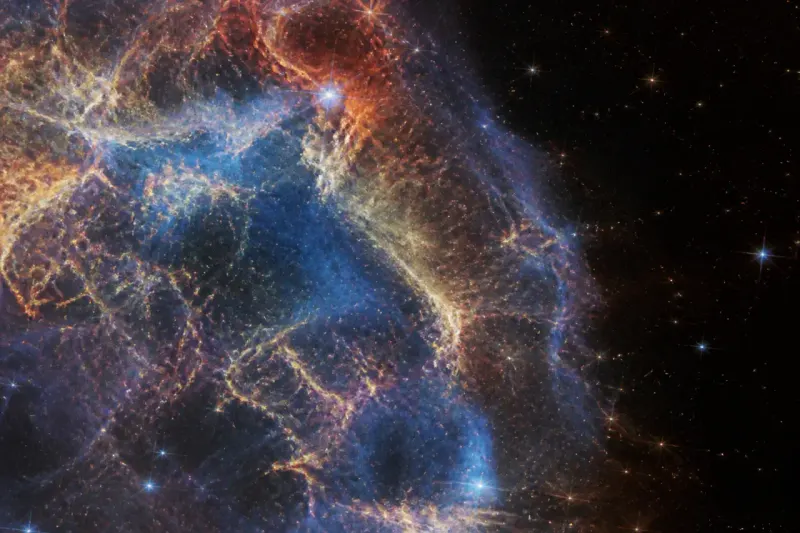
Understanding Supernovae with Advanced Telescopes
Finding order within the chaotic aftermath of a supernova explosion can be a complex task, but the James Webb Space Telescope (JWST) has the capabilities necessary to achieve this. Utilizing its Mid-Infrared Instrument (MIRI) and the Medium-resolution Spectrometer (MRS), researchers have begun to unravel the intricate chemical and structural details of supernova remnants, like that of Cassiopeia A (Cas A). This effort sheds light on the significant role massive stars play in the evolution of the universe.
Massive stars are essential for synthesizing the heavier elements found in the universe, known as astronomical metals. These metals are crucial for the formation of rocky planets and even life itself. In their later stages, these stars explode as supernovae, dispersing their contents, including metals, into the interstellar medium. This redistribution of elements is vital for nurturing future generations of stars and planets.
Cassiopeia A: A Key Supernova Remnant
Cassiopeia A is one of the most studied supernova remnants, located approximately 11,000 light-years away. Observed on Earth around 1667, it provides a unique opportunity for astronomers to investigate the characteristics of the progenitor star that led to this explosion. By analyzing Cas A's remnants, scientists can glean insights into the processes that occurred within the star leading up to the supernova.
Revolutionary Insights from JWST Observations
Recent research published in The Astrophysical Journal Letters focuses on dust emissions within Cas A and discusses the profound insights gathered from JWST's observations. Led by Tea Temim from Columbia University, the study utilized the MIRI and the MRS to examine the chemical makeup of the remnant, enabling researchers to isolate dust emissions from specific clumps of supernova ejecta.
The ability to identify these ejecta clumps on an arcsecond scale marks a significant advancement. Massive stars develop multiple layers of elements, with heavier elements formed in the star's core, which eventually mix during the supernova explosion. The remnants reflect these layers, offering a snapshot of the star's life and chemical composition prior to its demise. As they expand, shockwaves heat the ejecta, creating patterns in the debris that hint at its origins.
Revealing the Progenitor Star's History
Before utilizing the JWST, the research team employed data from the Spitzer Space Telescope, which helped identify regions of interest within Cas A. These regions, each characterized by distinct dust properties, were then examined in more detail using the JWST's MRS.
The researchers identified three key locations within the remnant denoted as P1, P2, and P3. Each region exhibits different spectral emissions, highlighting the varying compositions:
- P1: Found in reverse-shocked ejecta, this region shows bright argon emissions with predominance of SiO2 (silica) grains, suggesting a historical carbon–oxygen shell merger.
- P2: Known as Cas A's "Green Monster," this region is characterized by circumstellar matter on Cas A's near side, primarily composed of Mg2SiO4, displaying the distinct dust properties resulting from different origins.
- P3: Another reverse-shocked area, it has significant neon emissions compared to P1, pointing to a shell merger between carbon and oxygen layers.
Dust Composition and Supernova's Galactic Impact
Understanding the dust within supernova remnants is crucial for determining the overall contribution of supernovae to the interstellar dust reservoir. According to co-author Ilse De Looze from Ghent University, the discovery of these dust types also provides insights into their potential survival when subjected to reverse shocks, which can influence their dispersal into the interstellar medium.
The JWST's contributions ensure a clearer view of the chemical and physical processes at play, enabling scientists to draw connections between the progenitor star's pre-explosion state and the materials it subsequently releases into the universe. This work emphasizes the importance of high-resolution observations that can discern the nuanced details of young supernova remnants, enhancing our understanding of the stellar lifecycle.
Complementary Observations from Other Missions
The JWST's findings are integrated with data from the Japanese Aerospace Exploration Agency's (JAXA) XRISM X-ray satellite and NASA's Chandra X-ray Observatory, providing a multifaceted view of Cas A. Together, these observations illustrate that the progenitor star experienced significant shell mergers prior to its explosive demise, altering its internal structure and material composition dramatically.
These simultaneous observations across different wavelengths help construct a comprehensive picture of how supernovae enrich the galaxy with essential elements necessary for forming new stars and planets.
Significance for Future Research
The study illustrates how JWST has amplified researchers' ability to conduct sophisticated dust chemistry analysis through improved resolution at clump levels. As remarked by co-author Dan Milisavljevic from Purdue University, the findings illuminate the processes leading to the core collapse and the subsequent elements released into the galaxy. This deeper understanding is pivotal to grasping the mechanisms of star formation and the lifecycle of galactic matter.
Key Takeaways
- The JWST analyzed Cassiopeia A, a supernova remnant located 11,000 light-years away, to reveal its chemical makeup.
- Three regions of interest (P1, P2, P3) show distinct dust properties and implications of shell mergers prior to the explosion.
- Findings support the understanding of how supernovae enrich the interstellar medium with essential metals.
- Complementary missions like Chandra and XRISM enhance the comprehensive view of such supernova events.
Conclusion: The Ever-Deepening Mysteries of the Cosmos
The research conducted using the JWST serves to deepen the understanding of supernova remnants and the processes that govern stellar evolution. As astronomers continue to reveal the secrets hidden within remnants like Cassiopeia A, they build a clearer picture of the cosmos' history and how the elements needed for life are produced and disseminated through the universe. With each revelation, scientists move closer to answering foundational questions about the origins of stars, planets, and possibly life itself.
Frequently Asked Questions