
Euclid's Discovery of Dún Aonghasa: A Record-Breaking Quasar
Dún Aonghasa is the most distant quasar discovered by the Euclid Space Telescope, revealing insights into the formation of supermassive black holes.
New Insights into the Early Universe
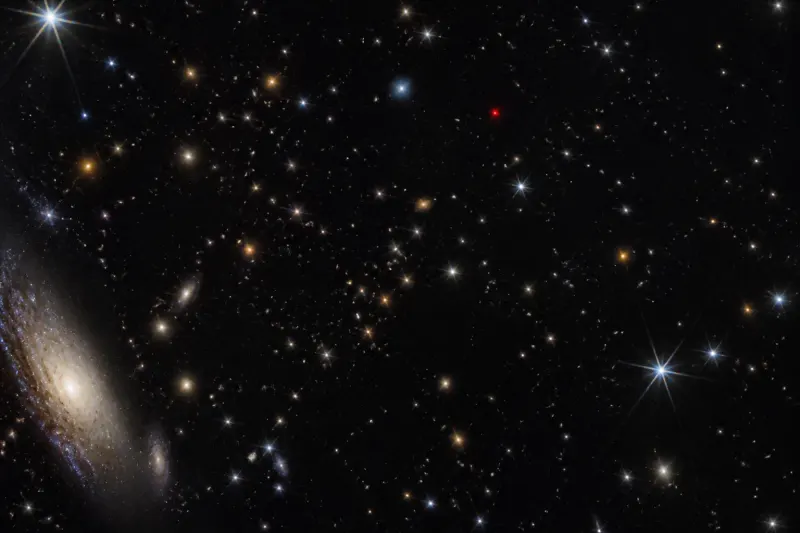
The recent discovery of a quasar named Dún Aonghasa has set a new benchmark for understanding the early Universe. Detected by the European Space Agency's (ESA) Euclid Space Telescope, Dún Aonghasa is recognized as the most distant and ancient quasar known, located at a redshift of z = 8.13, which corresponds to approximately 630 million years after the Big Bang. This finding extends the previous record by 40 million years, deepening our knowledge of black hole formation.
Significance of Dún Aonghasa
Dún Aonghasa hosts a supermassive black hole (SMBH) with a mass 360 million times that of our Sun. Its luminosity is so immense that it can be observed from such a vast distance. These quasars act as bright beacons, revealing the existence of ancient galaxies and overall cosmic evolution during a critical period known as the Epoch of Reionization.
How Quasars Are Formed
Quasars are produced when a supermassive black hole gathers significant amounts of surrounding gas and dust to form an accretion disk. This process generates intense luminosity as the material heats up before being consumed by the black hole. The accretion rates can influence the characteristics of the quasar, and Dún Aonghasa is no exception. Researchers observed that it is quite peculiar because its current feeding rate is relatively slow. This observation raises important questions about how such a massive black hole achieved its size in the early Universe.
Challenges in Understanding Early Black Hole Growth
One of the key challenges posed by the discovery of Dún Aonghasa is reconciling its large mass with current theories of black hole formation. Astrophysicists anticipate that it should typically take around 1 billion years of accretion and merging for a black hole to grow to such supermassive proportions. The fact that Dún Aonghasa achieved its mass in just a few hundred million years suggests that either these black holes grew much faster than models propose, or they formed with more massive seeds than previously understood.
Role of Follow-Up Observations
While Euclid initially detected Dún Aonghasa, the confirmation came through a series of subsequent observations from other prominent telescopes, including the Keck Observatory, Hubble, and the James Webb Space Telescope (JWST). The JWST played a significant role in measuring the quasar’s redshift accurately, leading to a refined understanding of how and when such quasars can form in the cosmic timeline.
The Dramatic Impact of Euclid's Discoveries
Launched in 2023, the Euclid Space Telescope's primary mission is to study dark energy and the expansion of the Universe. However, findings like Dún Aonghasa deepen our comprehension of the early cosmic environment. The observations are revealing insights about the intergalactic medium, including its opacity during reionization, as well as the distribution of matter throughout the Universe. By marking peaks in the matter distribution, quasars can help scientists unravel the complexities of cosmic structure formation.
Future Directions: More Quasars to Come
The potential for future discoveries is promising. Researchers project that Euclid could uncover between 8 to 23 quasars at redshifts greater than 8. This discovery could illuminate new aspects of how supermassive black holes grew during this epoch. Scientists believe that each new quasar found will contribute to addressing the questions surrounding the formation and growth processes of supermassive black holes.
Key Takeaways
- Dún Aonghasa sets a record as the most distant quasar at z = 8.13.
- The supermassive black hole in Dún Aonghasa has a mass of 360 million solar masses.
- This quasar was identified through data from the Euclid Space Telescope, followed by confirmation from JWST and other observatories.
- Understanding Dún Aonghasa poses questions about black hole growth in the early Universe.
- Euclid is expected to find more quasars, enhancing our understanding of cosmic evolution.
Conclusion: Implications for Astronomy
The discovery of Dún Aonghasa significantly contributes to the ongoing dialogue in astrophysics regarding black hole formation in the early Universe. It demonstrates how advanced observational techniques can extend our horizon of knowledge. As further discoveries are made, they will likely force scientists to reconsider the dynamics of black hole growth and the role of such quasars in the overall cosmos. The findings reinforce the idea that the more we uncover about the earliest parts of the Universe, the more questions arise, driving the quest for understanding deeper cosmic mysteries.
Frequently Asked Questions